
Commercial Waste
Commercial Dumpster Sizes: A Guide for Multi-Site Operators
2 to 8 cubic yards, what each size holds, and what actually decides the size at a real property.
Picking a container looks simple until the invoice arrives. Order too small and you pay for extra pickups, or for bags stacked beside a box that overflows every week. Order too large and you pay a monthly rate for air. Commercial dumpster sizes are measured in cubic yards, and the right one depends less on the size of your building than on what the site actually produces between pickups.
Here is what each front-load size holds, and what decides the size on a real property. If you need a temporary container for a build or a renovation, that is a roll-off, and the math works differently.
TL;DR
Commercial dumpster sizes are front-load containers measured in cubic yards. The standard range is 2, 4, 6 and 8 yard. Three things set the size: the volume a site generates, the type of business, and the room you have for the container. Size and pickup frequency are one decision, not two.
What are the standard commercial dumpster sizes?
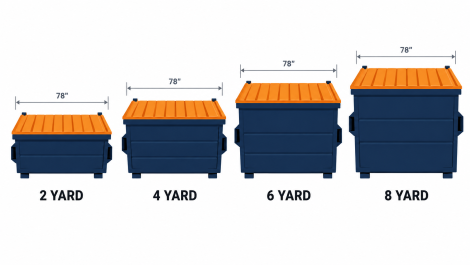
Standard front-load commercial dumpsters come in 2, 4, 6 and 8 cubic yard sizes, and the 4, 6 and 8 are the ones most locations end up on. The 1, 3 and 10 yard exist but are far less common. Specs vary by manufacturer and by market, so confirm dimensions on the ZTERS commercial waste products page for the container assigned to your site.
Commercial dumpster size chart
Capacity is shown in 96 gallon carts and in gallons, because carts are the unit most operators can count without guessing. One cubic yard is roughly 202 gallons, or about four carts.
| Size | Rough footprint | Holds about | Common fit |
|---|---|---|---|
| 2 yard | 6 ft W x 3 ft D x 3 ft H | 4 carts, 400 gallons | Salons, small offices, coffee shops |
| 4 yard | 6 ft W x 3 to 4 ft D x 4 to 4.5 ft H | 8 carts, 800 gallons | Restaurants, medical offices, small retail |
| 6 yard | 6 ft W x 5 ft D x 6 ft H | 12 carts, 1,200 gallons | Hotels, office parks, multifamily, restaurants |
| 8 yard | 6 ft W x 6 ft D x 7 ft H | 16 carts, 1,600 gallons | Grocery, warehouses, restaurants, multifamily |
How big is a 6 yard dumpster versus an 8 yard?
A 6 yard runs about 6 feet wide, 5 feet deep and 6 feet tall. An 8 yard keeps the same width, goes about 6 feet deep and stands close to 7 feet tall. Every front-load size shares that six-foot width, because the truck forks have to line up the same way every time. They grow taller and deeper instead, so overhead clearance stops properties far more often than width does.
What decides which commercial dumpster size you need?
Three things: the volume the site generates, the type of business, and the room you have for the container. Square footage on its own tells you almost nothing. A 3,000 square foot restaurant and a 3,000 square foot clothing store throw away completely different material.
Room constraints and the enclosure
Room constraints decide as often as volume does, and they are what force a busy site onto a smaller container. Check four things:
- Overhead clearance. The truck lifts the container over its cab to empty it, so a low canopy or a covered dock can rule out the size you wanted.
- Enclosure size and gates. Gates that swing inward, or bollards set tight to the pad, cost you working width even when the slab is big enough.
- A straight approach. The truck has to come at the container head-on, not back around a corner.
- Casters. If staff have to roll the container out on pickup day, it needs wheels. Ask at order time, and note these are typically available on 4 yard and smaller.
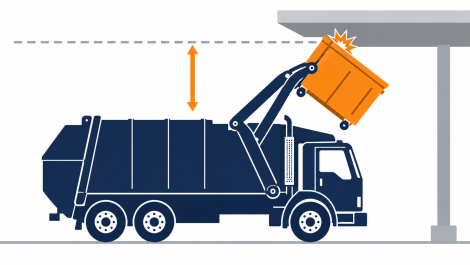
Commercial rear load exists for exactly these properties: the truck loads at the back at ground level, so it works where the ceiling is low or the approach is tight. Two options are worth asking for up front. A lock bar, because illegal dumping in your box is volume you pay for. A side door at 6 and 8 yards, where staff struggle to lift bags over the side.
Should you size up or add pickups?
Size up first. Extra hauls generally cost more per cubic yard than a larger container on the same schedule. Read the pad, not the invoice:
- Full before every pickup. Size up. Adding a haul solves the symptom at the higher price.
- Bags beside the box, or staff crushing boxes by hand. Undersized. You are buying labor to avoid buying volume.
- Routinely under two-thirds full. Oversized or over-serviced, and the more expensive problem, because nobody complains about it.
- Tight only in peak months. An extra pickup in the busy season beats carrying a bigger container all year.
Frequencies run from every other week up to 6 times a week. A nail salon sits at one end, a high-volume restaurant running multiple containers at the other. Set recycling alongside the trash rather than after it: the EPA recommends that recycling size and frequency at least match disposal service, because undersized recycling pushes material back into the container you are trying to shrink.
When do you outgrow commercial dumpster sizes entirely?
When no front-load size keeps up, the answer becomes a compactor. High volume producers are the ones that benefit: warehouses, distribution centers, manufacturing and light industrial. A stationary compactor packs waste into a detachable container that gets swapped out, which suits dry waste. A self-contained compactor seals the unit and container as one piece, for waste wet enough to leak. Either needs a pad, power and clearance, so it is a site decision rather than a container swap.
How do you right-size across multiple locations?
Use the same method at every site rather than deciding one at a time. Every location is different, so the containers will be too. The problem is that when each site was set up by a different local service provider in a different year, the differences come from history rather than from what the site actually needs.
- Run a waste assessment. It looks at what each location throws away and how often collection is actually needed, then sets size and frequency against real volume. The EPA describes this as establishing a baseline you can measure against.
- Stop guessing at fill levels. Z SIGHT shows how full a container actually is and whether the pickup happened, which is the fastest way to find sites paying for capacity they never use.
- Re-check after any change. A remodel, a new tenant, a menu change or a seasonal swing all move the number.
Frequently asked questions
What are the dimensions of a 4 yard dumpster?
About 6 feet wide, 3 to 4 feet deep and 4 to 4.5 feet tall, depending on the manufacturer. Width holds steady across front-load sizes, so overhead clearance is usually the limiting factor.
What size dumpster does a restaurant need?
It varies more than almost any other category. A quieter kitchen may run a 6 or 8 yard emptied once a week, while a high-volume location can run multiple containers 6 days a week. If deliveries leave you cardboard-heavy, a separate recycling container usually beats sizing up.
How many gallons is a 2 yard dumpster?
About 404 gallons, since one cubic yard is roughly 202 gallons, or four 96 gallon carts. A 4 yard is about 808 gallons, a 6 yard about 1,212 and an 8 yard about 1,616.
What is the difference between a commercial dumpster and a roll-off?
A commercial front-load dumpster stays at your location and is emptied on a recurring schedule, most often at 2, 4, 6 or 8 cubic yards. A roll-off is temporary, delivered for a project and hauled away when the job is done, in sizes from 10 to 40 cubic yards.
Can I change my dumpster size mid-contract?
Usually yes, though terms vary, and commercial agreements commonly run 12, 24 or 36 months. Ask how changes are handled before you sign. If you are locked in elsewhere, a letter of authorization lets ZTERS pull your current service details and build a proposal you can compare.
How ZTERS coordinates commercial dumpster service
ZTERS manages commercial waste service as one account across every location you run. Rather than sending our own trucks, we tap a vetted network of vendor partners and stay accountable for the whole account, in all 50 states. One contact, one plan and one invoice, instead of multiple points of communication. Pricing is all-in, so the invoice does not grow a column of line-item fees after you sign.
For sizing, one waste assessment sets size and frequency against what each location actually generates. Right-sizing usually means fewer pickups, and sometimes it means adding service to stop an overflow you were paying for in other ways. Savings depend on your number of sites and the mix of services.
Site Services Simplified. One partner. One contact. One invoice.
Ready to right-size the containers at every location? Get a free quote from ZTERS or call (888) 251-2660.