
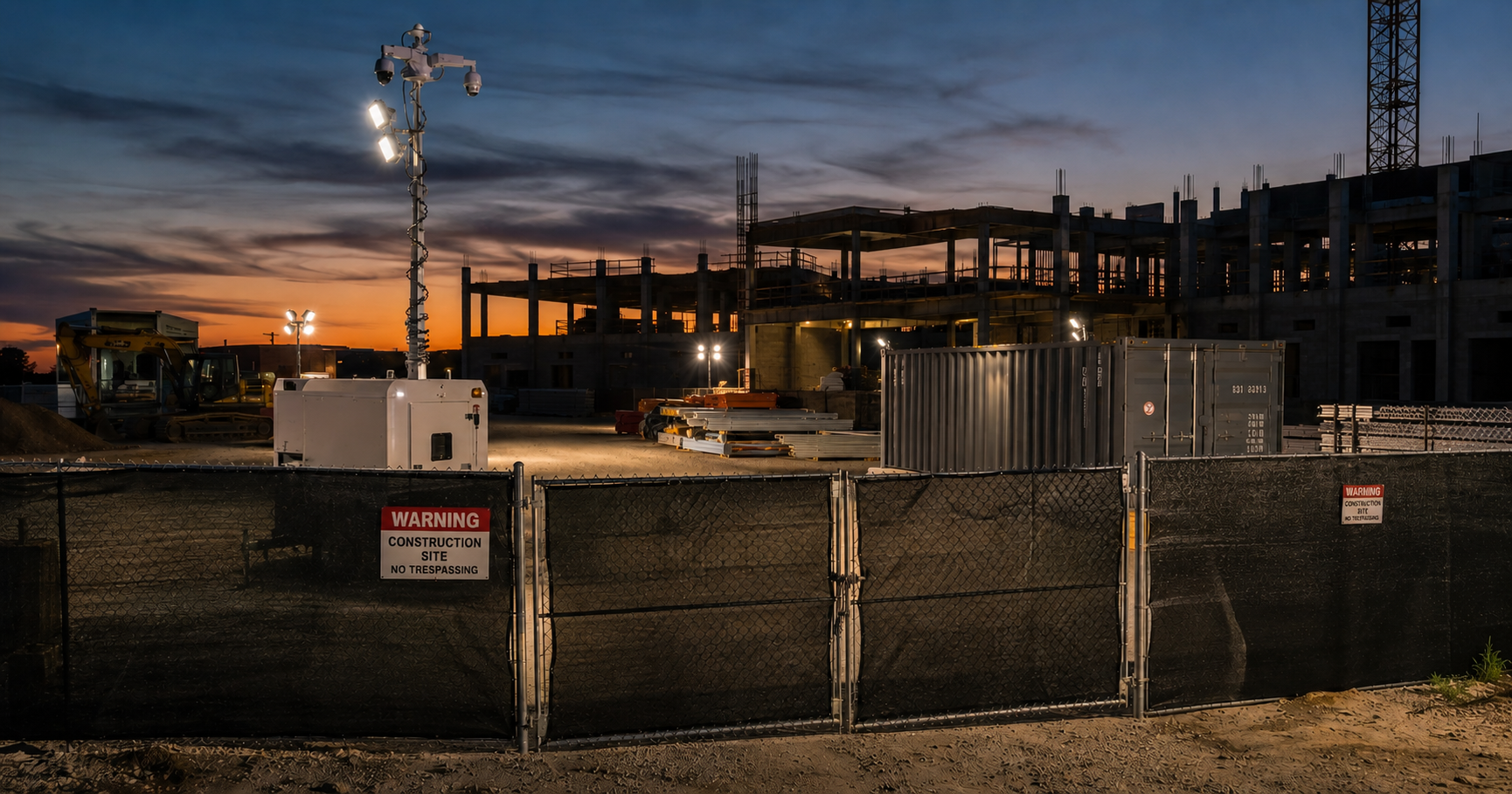
Jobsite Security
Construction Site Theft Prevention: How to Protect Your Jobsite
Theft drains hundreds of millions from construction every year, and less than 20% of it comes back. Here is how to make your site the harder target.
You lock the gate Friday. Monday morning the generator is gone, a compactor is gone, and the copper has been stripped out of the panel. No broken lock. No witnesses. No camera pointed the right way. Your crew stands around while you file a report you already know goes nowhere.
That is the math on jobsite theft, and it runs against you. Construction site theft prevention is the set of layers, physical, visible, and digital, that make your site too costly and too risky to hit, so the thief moves on. Here is what you are up against, and how to lock it down.
tl;dr
The short version: Construction site theft prevention is the layered system that keeps tools, equipment, and materials from walking off a jobsite: a secured perimeter, lighting, cameras, access control, equipment tracking, and a visible presence after hours. No single layer stops a determined thief, but stacked together they push most of them toward an easier target. Equipment theft costs the industry an estimated $300 million to $1 billion a year and less than 20% is recovered, so the win is in prevention, not recovery. One coordinated setup, managed by one partner, is faster to stand up than piecing it together vendor by vendor.
What is construction site theft prevention?
Construction site theft prevention is the combination of physical barriers, visible deterrents, and tracking technology that makes a jobsite too hard and too risky to rob. It works in layers, not with any one tool. A fence slows entry, lighting removes cover, cameras and alarms raise the odds of getting caught, access control limits who gets in, and equipment registration and GPS give you a shot at recovery if something still goes.
The goal is simple: change the risk math. A thief weighs how easy the target is against how likely they are to get caught. Stack enough visible layers, temporary fencing, motion lighting, cameras, and a security presence, and most of them decide your site is not worth it and move to the next one.
Why are construction sites such easy targets for theft?
Construction sites are easy targets because they are open, full of portable value, and empty on a predictable schedule. Around 11,000 equipment theft incidents are reported each year, roughly 1,000 a month, and less than 20% of that equipment is ever recovered, according to the National Equipment Register annual theft report. Most losses are permanent, and your company absorbs them. Here is why sites get hit:
- Open perimeters. A site with no fence or gate is an open invitation, and much of the theft is simply walk-on, drive-off opportunity.
- High-value, portable equipment. Generators, compactors, power tools, and copper wire are easy to load, easy to sell, and hard to trace once the serial number is gone.
- Predictable idle hours. Nights, weekends, and holidays are when sites sit empty, and thieves know the schedule as well as you do.
- Low recovery, weak deterrent. With recovery under 20% and few arrests, the risk to a thief is low unless you raise it yourself.
- Loose access. Subs, deliveries, and day labor move through all day, so an unfamiliar face or truck rarely gets a second look.
Roughly 85% of construction companies report some form of theft during operations. It is not a matter of if a site gets tested, but whether it holds up when it does.
How do you prevent theft on a construction site?
You prevent theft by layering deterrence, detection, and recovery so no single gap leaves the site open. Build it in this order:
- Secure the perimeter first. Fencing is the first line of defense. Chain-link around the full site, with a lockable gate, sets the baseline; add screening or barbed wire where high-value equipment sits overnight.
- Light it up. Thieves prefer the dark. Motion-activated lighting at regular intervals, roughly every 100 feet, removes hiding spots and makes any movement obvious.
- Add eyes that record. Cameras, solar-powered units, and mobile surveillance trailers give you both a live deterrent and evidence, and work even on remote or off-grid sites with no utility power.
- Control who gets in. One gated entry, a sign-in for subs and deliveries, and locked storage containers for tools cut down both opportunistic and insider theft.
- Register and track equipment. Record every serial number and register high-value gear with the National Equipment Register (NER). Add GPS trackers and geofencing so a machine that leaves the site flags an alert and can be traced.
- Immobilize and lock down. Wheel locks, kill switches, and hidden fuel shutoffs on heavy equipment turn a quick grab into too much work.
- Put a presence on site after hours. The single strongest deterrent is a visible human presence during off hours, whether a patrolled guard or a monitored, alarmed camera system that talks back.
You do not need every layer on day one. Start with the perimeter and lighting, add detection and access control as equipment arrives, and scale the setup for the phases when the most valuable gear is on site.
Want eyes on your site after hours?
Get a quote on mobile surveillance and intrusion detection built for construction sites, on the grid or off it.
Which security layers actually deter theft?
The layers that work fall into three jobs: deter, detect, and recover. A strong setup covers all three, because deterrence alone fails against a determined thief and recovery alone means the loss already happened. Use this to see what each layer buys you.
| Security layer | Tools | What it buys you |
|---|---|---|
| Deterrence | Perimeter fencing, motion lighting, signage | Most thieves skip your site for an easier one |
| Detection | Cameras, mobile surveillance trailers, alarms, guards | An alert and evidence while there is still time to act |
| Access control | Single gated entry, sign-in, locked storage | Fewer opportunistic and insider thefts |
| Recovery | NER registration, GPS trackers, serial records | A real shot at getting equipment back and blocking resale |
Authority note: Industry theft data and equipment registration are tracked by the National Equipment Register (NER) and the National Insurance Crime Bureau (NICB), whose records are checked by insurers, law enforcement, and auction houses. Registering high-value equipment and keeping serial numbers on file improves your odds of recovery and makes stolen gear harder to resell. Confirm the current programs and reporting steps at the National Equipment Register and the National Insurance Crime Bureau, and check your own insurance policy for any security requirements it sets.
What should you look for in a jobsite security provider?
Look for a provider that covers the whole perimeter, not just one gadget, and can scale with the job. The right partner ties the layers together so there are no gaps between them:
- Layered coverage. Fencing, lighting, cameras, and monitoring from one setup, so deterrence and detection actually connect.
- Off-grid capability. Solar-powered cameras and mobile surveillance trailers for sites with no utility power yet.
- Fast deployment. Equipment on site before the valuable gear arrives, not weeks after.
- Scalable by phase. Add or pull back coverage as the site moves from sitework to fit-out.
- Multi-site consistency. The same setup and single point of contact whether you run 1 site or 20 across different states.
Secure your jobsite before the next hit.
Get a free quote on intrusion detection and jobsite security from ZTERS, built to fit your site and scale across every location you run.
Frequently asked questions
How much does construction site theft cost?
Equipment theft costs the U.S. construction industry an estimated $300 million to $1 billion a year, with individual losses commonly running $6,000 to $30,000 per incident depending on the equipment. Because less than 20% of stolen equipment is recovered, most of that cost is permanent, which is why prevention pays off far more than chasing recovery.
What gets stolen most on a construction site?
Portable, easy-to-resell items are hit most: power tools, generators, compressors, and copper wire, along with smaller pieces of heavy equipment that can be loaded and driven off. The common thread is high value, low weight, and hard-to-trace resale, so those are the items to lock in storage, register, and track first.
Are security cameras worth it on a construction site?
Yes, especially monitored or solar-powered cameras that work on sites without utility power. Cameras deter theft when they are visible, provide evidence when something happens, and, when paired with live monitoring or a speaker, can stop a break-in in progress. They work best as one layer alongside fencing and lighting, not on their own.
Does a fence really stop jobsite theft?
A fence alone will not stop a determined thief, but it is the single most important starting layer. Perimeter fencing forces entry to one controllable point, slows anyone trying to remove equipment, and signals that the site is managed. Paired with lighting and cameras, it turns a quick opportunistic grab into a slow, exposed job most thieves will not attempt.
What should you do if equipment is stolen from a site?
File a police report right away with serial numbers and photos, report the theft to your insurer and to the National Equipment Register or NICB, and check any GPS or geofencing alerts for a last known location. Registered serial numbers are what let law enforcement and auction houses flag the equipment, so having them on file before a theft is what makes recovery possible.
How ZTERS coordinates jobsite security
ZTERS coordinates construction site theft prevention as one connected setup instead of a pile of separate orders. Rather than sending our own trucks, we tap a vetted network of vendor partners and stay accountable for the whole account. We arrange jobsite security, and pair it with the temporary fencing and storage containers that make the perimeter hold, so deterrence, detection, and lockup all come from one plan.
One point of contact owns security alongside dumpsters, restrooms, temporary fencing, and offices. Need the wider picture? Our guide on how to coordinate construction site services covers building the whole plan.
One point of contact. One plan. One invoice. Nationwide across all 50 states, whether you run a single site or 20. When you need to secure a site fast, you make one call, and the whole perimeter comes together. Savings depend on your number of sites and the mix of services, but the coverage is coordinated the same way on every job.
Site Services Simplified. One partner. One contact. One invoice.