
Commercial Waste Services
Apartment Dumpster Guide: Size, How Many, and Rules
What size, how many, how often, and the rules that keep your enclosure clean. A practical setup guide for property managers and multifamily owners.
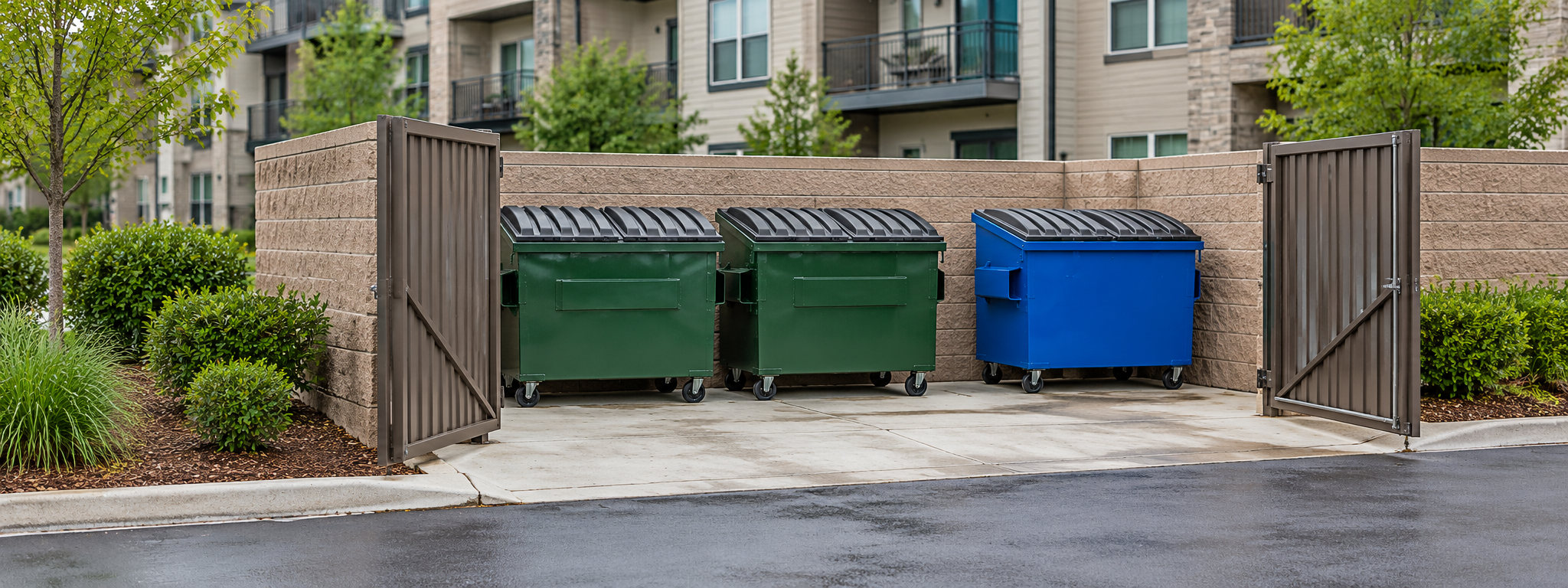
Your apartment dumpster was emptied two days ago at half full. Today the gate is propped open, two mattresses are leaning against the wall, and flattened cardboard nobody flattened is stacked beside the container instead of inside it. You are paying for a pickup you did not need and fielding complaints about the mess that is still there.
Apartment trash service goes wrong in small ways that stack up. Wrong size. Wrong frequency. No rules posted anywhere. Nowhere for a mattress to go. Here is how to size the service, how often it should run, and which rules actually hold up at the enclosure.
The short version
Most apartment properties run front-load dumpsters in 4, 6 or 8 yard sizes on a set pickup schedule.
- Size. A 4, 6 or 8 yard front load for most properties. A 2 yard for small properties and tight courtyards, a rear load where a front-load truck cannot square up to the enclosure.
- How many. No universal formula. Unit count, occupancy, the turnover calendar and how far residents will walk all move the number.
- How often. Anywhere from every other week to six times a week. Set it from how full the containers actually are, not from an assumption made at contract signing.
- Rules. Five rules posted at the enclosure beat a paragraph in the lease. Bag it, flatten the boxes, lids closed, recyclables in recycling, bulky items called in.
- Compliance. Multifamily recycling is mandatory in a growing number of cities, with a different unit threshold and a different filing requirement in each one.
Get size, frequency and rules right and overflow, illegal dumping and pickups you paid for twice mostly stop being your problem.
What size dumpster does an apartment complex need?
Most apartment properties land on a 4, 6 or 8 yard front-load dumpster. Standard front-load sizes run 2, 4, 6 and 8 yard, and those three are where most properties end up.
The 1, 3 and 10 yard containers do exist. They are uncommon, and the 10 yard especially. Treat them as options to ask about rather than a starting point. Small properties and tight courtyards sometimes work better on a 2 yard container, which can come with casters so your maintenance staff can roll it out for service instead of waiting on a driver to reach it. Where the enclosure sits in a narrow alley or behind a gate with a tight swing, a commercial rear-load container is often the better fit.
Three things set the size. Square footage is not one of them.
- Volume your property actually generates. Unit count is the starting point, but occupancy, resident mix and how much packaging arrives at the door move the number more than the unit count alone suggests.
- How often service runs. Size and frequency trade against each other. A smaller container serviced three times a week and a larger one serviced once can hold the same weekly volume, and one of them will fit your enclosure and one will not.
- Room constraints. Enclosure footprint, gate swing, overhead clearance and whether the container needs casters to get to the truck. This is the one that most often overrules the first two.
| Container | Where it tends to fit | Check first |
|---|---|---|
| 2 yard front load | Small properties, tight courtyards, a second container for an outbuilding | Whether casters are needed so staff can move it to the truck |
| 4 yard front load | Smaller properties, or one of several containers spread across a larger site | Service frequency, since a smaller container usually means more pickups |
| 6 and 8 yard front load | The common choice for most apartment properties | Enclosure footprint and overhead clearance for front-load service |
| Commercial rear load | Narrow alleys, tight gate swings, enclosures a front-load truck cannot square up to | Whether a rear-load truck can reach the staging spot |
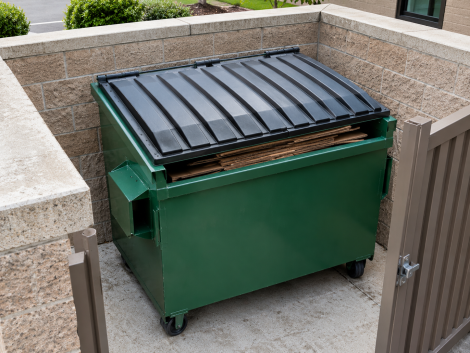
Container dimensions vary between service providers, so measure your enclosure and confirm the exact footprint for the containers you are quoted before you commit to a size. If you would rather have that checked against your actual enclosure, ask for a quote with the container footprint confirmed.
How many dumpsters does an apartment complex need?
There is no universal formula, and anyone who hands you one without looking at your property is guessing. How many containers you need depends on unit count, occupancy, the move-in and move-out calendar, how far residents are willing to walk, and how often service runs.
Some cities publish planning guidance you can use as a rough sanity check. Seattle, for example, has designers plan multifamily garbage capacity at about 1 cubic yard per 10 units per week, and recycling at about 1.5 cubic yards per 10 units per week, under its solid waste storage and access requirements. That is Seattle’s number for new and remodeled buildings, not a national standard and not a ZTERS rule. It is useful as a ballpark, not as a quote.
Here is the honest version of how this has always worked. Property managers size service on assumptions, because nobody is standing at the enclosure at 6 a.m. on pickup day counting how full the container was. The assumption gets set once, at move-in or at contract signing, and then it never gets revisited. Occupancy changes, a building comes online, a summer turnover season doubles the volume, and the service level stays exactly where it was.
Cameras change that. Z SIGHT measures how full each container actually is before the truck arrives, so the size and the number of containers get set on what your property really produces instead of what somebody estimated two years ago. It is on roughly 1,000 locations. Stop guessing, start seeing.
How often should apartment dumpsters be picked up?
Apartment properties run anywhere from every other week up to six times a week. A small property with low turnover sits at one end of that range. A large, fully occupied community in peak season sits at the other.
Both ends of getting it wrong cost you. Too little service means overflow, trash on the ground, pest complaints and residents who start leaving bags next to the container because the lid will not close. Too much service means you are paying a truck to drive out and empty a container that is a third full.
Right-sizing usually means fewer pickups, and that is where the savings come from. But not always. Sometimes the fill data says the container is going out at 100 percent every single time and the right answer is to add a pickup or a second container. A real waste assessment tells you which one you are looking at. Guessing does not, and guessing wrong in the overflow direction is the expensive mistake, because the cleanup, the complaints and the pest problem all land on your maintenance budget.
Right-size your service
Still paying for pickups you do not need?
A waste assessment looks at your container sizes, your pickup schedule and how full the containers really are, then sets the service level your property actually needs. It costs nothing, and properties already under contract elsewhere can still get a proposal.
Apartment dumpster rules for residents
The apartment dumpster rules that hold up are the ones a resident can follow without thinking about it: bag the trash, break down the boxes, keep it inside the container, and put recyclables in the recycling. Five rules, posted where people can see them, do more for your enclosure than a paragraph in the lease nobody reads.
What can and cannot go in the dumpster
Bagged household trash goes in. Hazardous materials do not, and that list is longer than most residents assume: paint, motor oil, solvents, pool chemicals, pesticides, propane tanks, car batteries, and in most places electronics and fluorescent bulbs. Bulky items like mattresses and furniture do not go in either, which is the rule residents break most often because they have nowhere else to put them. Give them somewhere else to put them and the problem shrinks.
Break down cardboard boxes
One intact moving box can take up the space of a week of bagged trash. Flattened, it takes almost nothing. This is the single highest-leverage rule you can post, because online ordering means your containers fill with air inside boxes rather than with actual waste. If you can only get residents to follow one rule, make it this one.
Keep lids closed and trash inside the container
A propped lid is an open invitation to rodents, raccoons, flies and odor complaints from the units nearest the enclosure. Bags left on the ground beside a container get torn open overnight, every time. Closed lids and nothing on the ground is also what keeps you off the wrong side of a code inspection.
Use recycling containers for recyclables
This one is self-interested as well as civic. Every cardboard box and bottle that goes into the recycling container is volume that is not filling your trash container, which is capacity you do not have to buy. The flip side matters too: a recycling container with trash bags in it can get flagged as contaminated and billed as trash, so the signage has to be clear about what belongs where.
Post clear signage in the enclosure
Rules nobody can see are not rules. Put signs on the containers themselves and at the enclosure gate, in the languages your residents actually speak, naming which container takes what, what is not accepted, and who to call about a bulky item. Several cities require this, and specify sign size and wording, so check your local rule before you order signs. It is also the cheapest fix on this list.
Apartment dumpster rules for properties: local ordinances
Multifamily recycling requirements vary by city and state, and in a growing number of places they are not optional. The rules usually cover four things: how many units trigger the requirement, how much recycling capacity you have to provide per unit, who is allowed to collect it, and what you have to file and post to prove you are compliant.
Austin is a good example of how specific these get. Under the city’s multifamily recycling and composting requirements, properties with five or more units have to provide single-stream recycling, either matching their landfill trash capacity or providing 24 gallons of recycling capacity per unit per week, and since October 2024 they also have to provide composting collection. There is an annual recycling plan to file, a 25-foot rule for how far recycling containers can sit from trash containers, and signage requirements in at least two languages. ZTERS helps properties in Austin meet those requirements.
Dallas takes a different cut at the same problem. Its multifamily recycling ordinance applies at eight or more units, sets a minimum of 11 gallons of recycling capacity per unit per week with weekly collection, requires you to use a city-permitted recycling collector, and requires an annual recycling plan with an affidavit of compliance plus staff and resident education. Same goal, different thresholds, different paperwork.
| City | Applies to | Recycling capacity | Also required |
|---|---|---|---|
| Austin, TX | 5 or more units | Match trash capacity, or 24 gallons per unit per week | Composting collection, annual recycling plan, bilingual signage |
| Dallas, TX | 8 or more units | 11 gallons per unit per week, collected weekly at minimum | City-permitted collector, annual plan and affidavit, staff and resident education |
| Seattle, WA | New and remodeled buildings, 5 or more units | About 1.5 cubic yards per 10 units per week | Food and yard service, storage and access plan review |
These figures come from each city and are current as of publication. Thresholds, capacity minimums and filing deadlines change, and plenty of cities not listed here have their own rules. Confirm the current requirement with your local solid waste department before you build your service plan around it, and ask whether your state has a separate multifamily recycling mandate layered on top.
Keeping the enclosure clean
A clean enclosure comes down to three fixes: keep outsiders out, give bulky items a route off the property, and move recyclable volume out of the trash container. Signage and resident reminders help, but these three change the physical situation.
Lock bars to stop outside dumping
If your containers sit near a street or a shared lot, some of what goes in them is not coming from your residents. Contractors, nearby businesses and passing households all find an unsecured apartment dumpster convenient, and you pay for the capacity they use. Lock bars are available on request and are the simplest fix. Pair one with a gate that actually latches, because a lock bar on a container inside a propped-open enclosure does not accomplish much. Illegal dumping is easier to prevent than to clean up after.
Bulky items like mattresses, couches and dressers
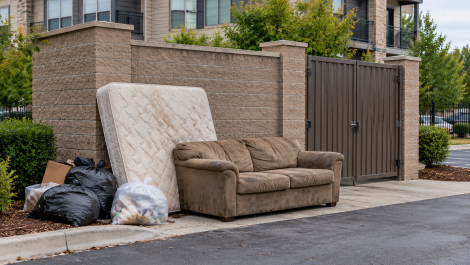
Furniture does not fit in a front-load container and should not go in one, which is why it ends up leaning against the enclosure wall instead. The answer is a route off the property, not another sign. On-demand junk removal or scheduled bulky item pickup gives your staff something to tell a resident who is replacing a mattress, and gives you a way to clear the pile after a turnover weekend without tying up a maintenance truck. Properties with heavy move-out seasons often find it worth scheduling these in advance around the turnover calendar rather than calling after the pile appears.
Recycling to free up trash capacity
Recycling is usually, though not always, cheaper per yard than trash, and every yard you divert is a yard your trash container does not have to hold. Cardboard is the obvious win at an apartment property because it is high volume, easy for residents to separate, and the thing most likely to be jamming your container. Mixed recycling, organics and food waste collection are available in many markets, depending on what local facilities accept. Where a multifamily composting mandate applies, as in Austin, that stream is not optional anyway, so it is worth setting it up properly the first time.
How ZTERS coordinates apartment dumpsters across multiple properties
Running trash service at one property is a task. Running it across a portfolio is a different job, and it is usually the invoices that make it one. Different service providers in different markets means different billing cycles, different service levels, different people to call, and no single view of what any of it is costing you.
ZTERS arranges and manages commercial waste services through a vetted network of local service providers, and stays accountable for the whole account regardless of who is driving the truck. That means one point of contact for every property, one plan, and one invoice, in all 50 states. Here is what that looks like in practice:
- One contact and one invoice. Your account manager handles a missed pickup in one market and a size change in another, and the whole portfolio arrives on a single bill.
- All-in pricing. No separate line-item fees stacked onto the invoice after the fact, so the number you approved is the number you see.
- Fill data, not assumptions. Z SIGHT measures container fullness, verifies that pickups actually happened, and shows what is inside the container, so service levels get set and adjusted on real numbers.
- Terms that fit the hold period. Contracts run 12, 24 or 36 months.
- A proposal even if you are locked in. Properties already under contract with another service provider can still get a proposal through a letter of authorization, so you can see the comparison before your current term ends.
For a wider look at how this fits together across a portfolio, see our guide to apartment complex waste services, or the breakdown of temporary versus permanent waste solutions if you also run renovation and turnover projects that need roll-off containers.
Site Services Simplified. One partner. One contact. One invoice.
50 states
Service arranged through a vetted network of local service providers
One invoice
Every property on a single bill, with all-in pricing and no fees added after the fact
12, 24 or 36
Month terms, so the contract can match your hold period
Frequently asked questions
What size dumpster does an apartment complex need?
Most apartment complexes use a front-load dumpster in the 4, 6 or 8 yard range. Standard front-load sizes are 2, 4, 6 and 8 yard. The right size depends on how much volume your residents generate, how often service runs, and how much room your enclosure has, including gate swing and overhead clearance. Square footage is not a useful guide.
How many dumpsters does an apartment complex need?
There is no universal formula. The number depends on unit count, occupancy, your move-in and move-out calendar, how far residents will walk to a container, and how often service runs. Some cities publish planning guidance you can use as a rough check. Seattle, for instance, has designers plan multifamily garbage at about 1 cubic yard per 10 units per week. The most reliable approach is measuring how full your containers actually are before pickup and sizing from there.
How often should apartment dumpsters be emptied?
Apartment properties run anywhere from every other week up to six times a week. Too little service causes overflow, bags on the ground and pest complaints. Too much means paying to empty containers that are only a third full. Fill data from the containers themselves is the fastest way to find the right frequency, and it sometimes points toward adding service rather than cutting it.
Can apartment residents put furniture in the dumpster?
No. Mattresses, couches, dressers and similar bulky items do not belong in a front-load dumpster. They take up the capacity of a week of bagged trash, they can prevent the container from being emptied properly, and many service providers will not take them. Handle bulky items as on-demand junk removal or scheduled bulky item pickup instead, and tell residents who to call so the items do not end up leaning against the enclosure wall.
Are apartment complexes required to offer recycling?
It depends on where the property is. Multifamily recycling mandates vary by city and state. Austin requires properties with five or more units to provide single-stream recycling and, since October 2024, composting collection. Dallas requires recycling at properties with eight or more units, with a minimum of 11 gallons of capacity per unit per week. Many cities have no requirement at all. Check with your local solid waste department, and ask whether your state has a separate mandate.
How do I stop people from dumping in my apartment dumpster?
Secure the container and the enclosure together. Lock bars are available on request and stop casual outside dumping. They work best paired with a gate that latches, clear signage, and adequate lighting. Cameras on the containers also help, because fullness and contents data shows you when a container is filling faster than your residents can explain. If outside dumping is constant, it is usually a sign the enclosure is too easy to reach from a street or shared lot.
Next step
Ready to right-size apartment dumpster service across your properties?
Tell us the properties, the unit counts and what is going wrong at the enclosure. You get one plan, one contact and one invoice across all of them, and a proposal you can compare before your current term ends.