
Construction Site Services
Construction Site Dumpster: Placement, Permits and Swaps
Where the container sits, how often it gets pulled, and what changes when you are running containers on four jobsites instead of one.
A construction site dumpster is not one decision. It is a placement decision, a scheduling decision, and on a multi-site job, a coordination decision. Get the first one wrong and every swap after it costs you time you did not budget for. The box sits in the wrong spot, the truck cannot reach it, and the crew works around a full container for two days.
Size and cost are covered elsewhere. What size dumpster do I need breaks down 10, 20, 30 and 40 yard roll-offs by project type, and how much it costs to rent a dumpster covers pricing. Here is the operational side: where the container sits, how often it gets pulled, how to keep it usable, and what changes at four sites instead of one.
The short version
A construction site dumpster is a roll-off container placed on an active jobsite to hold construction and demolition debris between hauls. It works when three things line up: a spot a roll-off truck can actually service, a swap schedule tied to the build phases instead of to how full the box looks, and a loading rule the subs follow. Get those right and the container stops being a daily decision. Get them wrong and you pay for dry runs, rejected loads and crews walking debris further than they should.
What is a construction site dumpster?
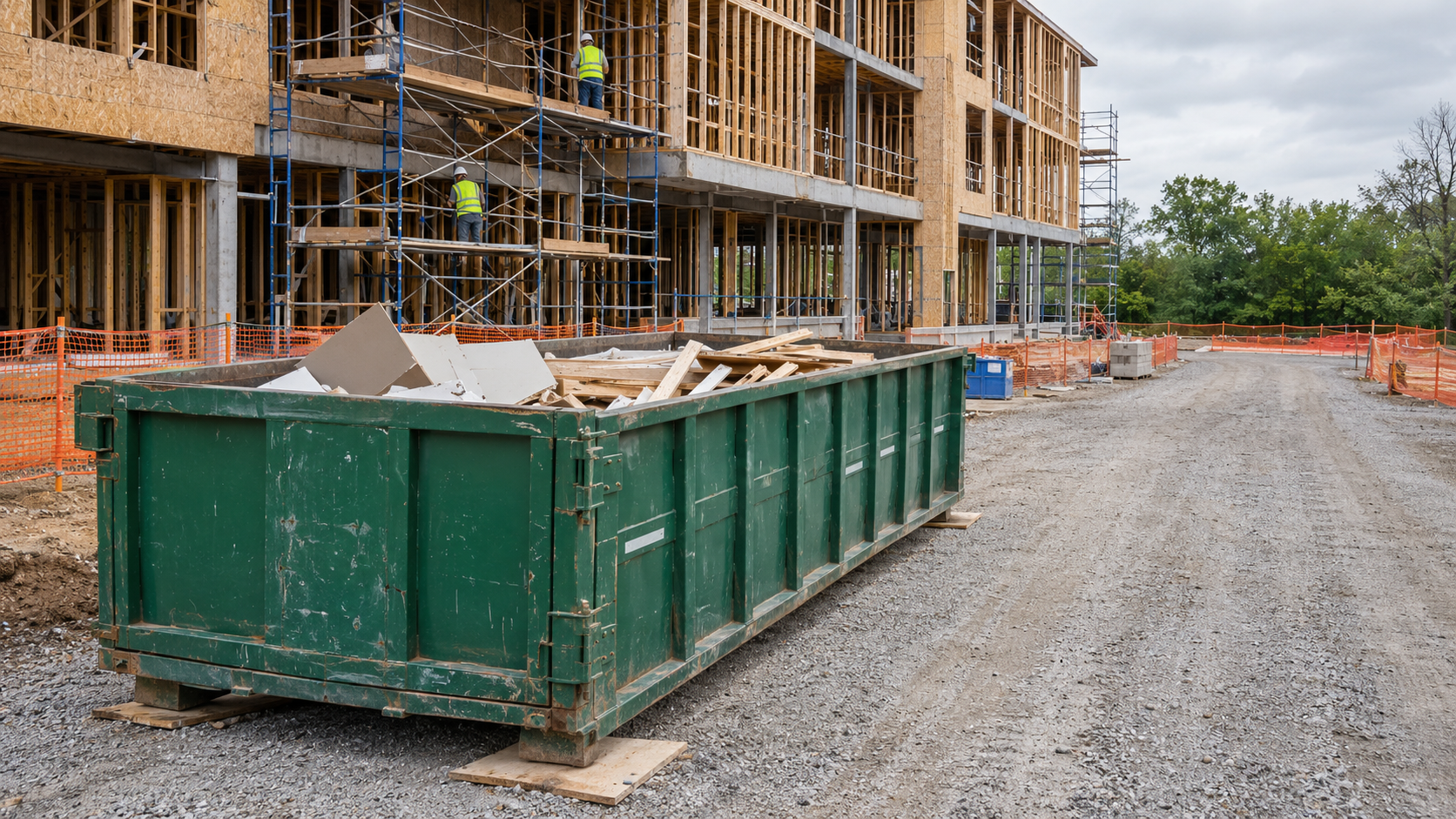
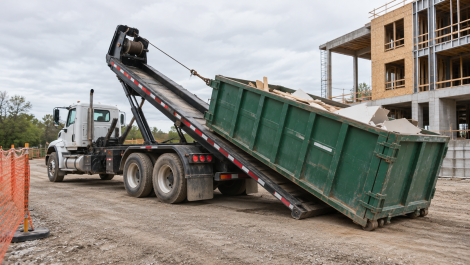
A construction site dumpster is an open-top roll-off container placed on an active jobsite to collect construction and demolition debris until a truck hauls it away and drops an empty one in its place. It sits on the ground on steel rails. It is serviced by a roll-off truck that tilts its bed and winches the box on, which is why the ground and the approach matter as much as the size.
Most of what goes in it is the ordinary debris stream of a build: framing scrap, drywall, roofing, concrete, metal, packaging and general jobsite trash. The EPA groups these as construction and demolition materials and treats a large share of the stream as recoverable, which matters if your project is tracking diversion for a client or a certification.
A roll-off is temporary service for a project with an end date. Ongoing collection for an occupied building runs on different equipment and a different agreement, which is the split covered in temporary vs permanent waste solutions for job sites.
Where should a construction site dumpster be placed?
Put it where a roll-off truck has a straight approach, overhead clearance and firm ground, close enough to the work that crews will actually walk to it, and clear of egress routes, fire lanes and parking. The spot you pick sets the ceiling on how fast the container can be serviced for the rest of the job.
That is the part teams underrate. If the container ends up wedged between a material lay-down area and a scaffold leg, the driver either waits for someone to move something or leaves without it. Plan the box into the site layout alongside the perimeter, the access lanes and the storage containers, not after everything else has claimed its ground.
Access and clearance for the roll-off truck
Walk the approach before the first delivery, not on the morning of the first swap.
- Overhead obstructions. Power lines, low branches, canopies and sign arms all sit in the arc the bed travels through when it tilts.
- Gate and lane width. Measure the pinch point, not the entrance. A gate the delivery truck cleared is not proof the next truck clears it with a loaded box.
- Straight pull. A roll-off needs room to line up square behind the container. A spot that requires an angled winch is a spot that gets skipped.
- Firm ground. A container that has settled into mud or fresh fill is a dig-out, not a pickup. Plywood or steel plate under the rails solves it cheaply.
- Walking distance. A container nobody wants to walk to produces debris piles instead, and those piles become their own cleanup line item.
Public right-of-way versus private property
If the container sits on private property with the owner’s consent, you usually skip the permit. If it occupies a street, sidewalk or alley, you are in permit territory and the rules are set locally, not nationally.
The detail that catches multi-market contractors out is who is allowed to apply. In some cities the permit is pulled by the licensed provider rather than by the contractor, and in others the application has to name the exact dates and footprint. Our guide to dumpster permits covers who pulls one and how the requirements shift city to city. Either way, confirm the rule with the municipality that governs the address, because a container cited on day one holds up everything behind it.
What does OSHA require for debris and containers on a construction site?
OSHA’s housekeeping standard for construction, 29 CFR 1926.25, sets three requirements that bear directly on how you use a container: keep debris clear of the work area, remove combustible scrap at regular intervals, and provide containers for collecting and separating waste.
- Clear the work areas. Paragraph (a) requires that during construction, alteration or repairs, “form and scrap lumber with protruding nails, and all other debris, shall be kept cleared from work areas, passageways, and stairs, in and around buildings or other structures.”
- Remove combustibles on a schedule. Paragraph (b) requires that “combustible scrap and debris shall be removed at regular intervals during the course of construction,” and that safe means be provided to facilitate that removal.
- Separate the streams, and cover the hazardous ones. Paragraph (c) requires containers “for the collection and separation of waste, trash, oily and used rags, and other refuse.” Containers used for garbage and other oily, flammable or hazardous wastes have to be equipped with covers, and waste has to be disposed of at frequent and regular intervals.
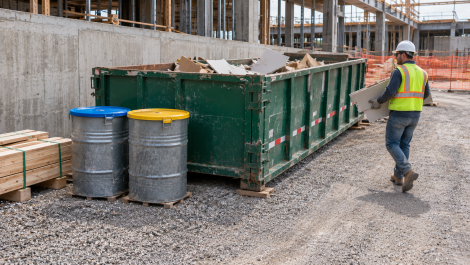
The practical reading is that one open roll-off is often not enough. If your crew generates oily rags, solvent containers or food waste alongside general debris, the standard points toward separate, covered containers for those streams. That is a site layout question as much as a compliance one, because every extra container needs its own serviceable spot.
Authority note: standards get revised, and state plan states can enforce requirements stricter than the federal rule. Confirm the current text of 1926.25 and your state plan before you write any of this into a site safety plan. Restroom counts sit under a separate standard, which we cover in OSHA porta potty requirements for construction sites.
How often should a construction site dumpster be swapped?
Tie the swap cadence to the build schedule, not to the fill level. Set a standing frequency for the steady phases, then add scheduled extra pulls around the days you already know will produce a burst. Reactive calls after the box is full are what cost crews time.
Demolition and framing generate debris in bursts. Mechanical rough-in, drywall and finish generate it steadily at a lower rate. The phases do not just change how much debris you get, they change what is in the box, which changes the size that makes sense.
| Build phase | What the debris looks like | Container plan | What catches teams out |
|---|---|---|---|
| Demolition and tear-off | Heavy and dense: concrete, brick, plaster, roofing | Smaller box, scheduled pulls on the known heavy days | Reaching the fill line long before the box looks full |
| Sitework and foundations | Soil, broken concrete, forming scrap | Dedicated box for clean fill where the facility separates it | Mixing soil into general debris and losing the separation |
| Framing and envelope | Bursty and bulky: lumber, sheathing, banding, packaging | Larger box, standing frequency with extra pulls at peak | Protruding nails and scrap piling up in passageways |
| Mechanical and drywall | Steady, bulky, light: board scrap, cardboard, offcuts | Standing frequency, one extra pull when the scrap comes out | Volume filling the box faster than anyone expected |
| Finish and punch | Light and mixed, plus packaging and general trash | Smaller box, less frequent pulls, final haul at closeout | Subs dumping the last of their own waste on the way out |
Treat the table as a starting point for the conversation with your provider. Actual cadence depends on crew size, how much the subs bring in, and what the local disposal facility will take in a mixed load.
What to settle before the first delivery
- Lead time for a swap request. Your superintendent needs to know whether a Thursday call gets a Friday truck or a Monday one.
- What happens on a blocked pull. A truck that arrives and cannot take the box is usually billable, so agree how that gets handled before it happens.
- Who can request a swap. Name the people on your side who can call it in, so a sub does not order a second box nobody budgeted for.
- The prohibited list for your market. Get it from the facility that actually takes the load, not from a generic page.
- The closeout haul. Put the final pickup on the schedule at mobilization, so the last box is not sitting on a finished site.
What goes in the container, and what needs a different service?
General construction and demolition debris goes in the roll-off. Prohibited items, hazardous waste and anything the disposal facility will not accept need a separate arrangement. A container that cannot be hauled is worse than no container, because the debris is already in it, and two things cause that.
Prohibited material and rejected loads
A single prohibited item can turn a routine haul into a rejected load. Paint, solvents, fuel, batteries, tires, appliances with refrigerant and anything with asbestos are the usual culprits, but the governing list comes from your disposal facility and varies by market.
Post that list at the container and brief the subs at mobilization. Subcontractors who did not order the box are the most common source of a contaminated load, and so is the public: an unsecured container near a street collects household junk overnight. Material the roll-off cannot take still has to go somewhere, which is where a scheduled junk removal pickup or a specialty disposal run comes in. Our guide to what can and cannot go in a roll-off dumpster covers the general rules.
Overloading and the fill line
A box loaded above the rails cannot be legally tarped or transported, so the haul does not happen. Heavy material reaches the limit long before it fills the volume: concrete, brick, soil and roofing tear-off all run out of allowance while the box still looks half empty, which is why a 40 yard container is usually the wrong choice for a concrete job. Smaller boxes swapped more often beat one large box that cannot move. Dumpster weight limits and overage fees, explained walks through how limits and overages are set, and they vary by market and agreement, so confirm yours.
How do you manage dumpsters, fencing and restrooms across multiple jobsites?
Standardize the request process, keep counts and service frequency in one place, and consolidate providers so you are comparing like with like. Everything above gets harder at scale, and it fails in a specific way: one site runs out of container capacity while another has a half-empty box being billed, and nobody sees it because each superintendent only has visibility into their own site.
- One request path. A swap gets asked for the same way from every site, rather than through whichever phone number a given super happens to have.
- One record of what is on the ground. Container counts, sizes and service frequency live in one place, not in individual inboxes.
- Fewer providers. Reconciling four invoices with four different fee structures is its own job, and it hides the site that is overpaying.
- The same pattern across services. Fencing, restrooms and storage fail the same way, which is why the fix is a shared process rather than a per-service one.
One process across every market you work in
Consolidation is where working through one coordinating partner differs from booking direct with local service providers in each market. Our breakdown of site services broker vs. direct vendor walks through that tradeoff honestly, and multi-state site services covers which coverage model holds up when the work crosses state lines. Containers are also only one of the services a jobsite needs on day one, which is the ground covered in how to coordinate construction site services.
What should you look for in a construction dumpster provider?
Look for coverage in every market you build in, a named contact who knows your sites, and written answers on lead times and blocked pulls. Price per haul is the easiest thing to compare and the least useful, because a cheap haul that arrives two days late costs more than the difference.
- Coverage where you actually work. A provider strong in one metro and absent in the next puts you back to sourcing locally, which is the problem you were solving.
- A named point of contact. Someone who knows which of your sites are in demo and which are in finish, so you are not re-explaining the job every call.
- Lead times in writing. Standard swap turnaround, and what a same-day request costs you.
- A clear dry run policy. What happens when the box is blocked, and what it costs when it is nobody’s fault.
- Billing you can reconcile. Line items that map to sites and hauls, so a project manager can check an invoice without a spreadsheet exercise.
- More than one service. If the same partner handles fencing, restrooms and storage, mobilization becomes one order instead of four.
How ZTERS coordinates construction site dumpsters
ZTERS coordinates roll-off dumpsters for jobsites in all 50 states. Rather than sending our own trucks, we tap a vetted network of vendor partners and stay accountable for the whole account, which means one point of contact and one ordering process across your sites instead of a separate relationship in every city. One plan. One contact. One invoice.
We also coordinate portable restrooms, temporary fencing, storage containers and portable offices, so a mobilization order can cover the whole site rather than four separate calls. If you are standing up a new site, how to create a construction site checklist is a starting point for what to line up before the crew arrives.
Site Services Simplified. One partner. One contact. One invoice.
Frequently asked questions
How many dumpsters does a construction site need?
It depends on the phase and on how much you are separating. A single-family remodel usually runs one roll-off at a time with scheduled swaps. A larger project separating streams for diversion, or generating oily rags or flammable waste alongside general debris, often needs more than one container. OSHA 1926.25(c) requires containers for the collection and separation of waste, trash, oily and used rags and other refuse, with covers on the ones holding oily, flammable or hazardous waste.
Where should a dumpster be placed on a construction site?
Somewhere with a straight truck approach, overhead clearance, firm ground, and no conflict with egress routes, fire lanes or material staging. Keep it close enough to the work that crews will actually walk to it, because a container nobody wants to walk to produces debris piles instead. Walk the approach before the first delivery rather than on the morning of the first swap.
Do you need a permit for a dumpster on a construction site?
Usually not if it sits on private property with the owner’s consent. Usually yes if it occupies a street, sidewalk, alley or other public right-of-way, and the requirements are set locally. In some cities the contractor is not the party permitted to apply, so confirm with the municipality that governs the address.
How often should a construction dumpster be swapped?
Set a standing frequency matched to your steady phases, then schedule extra pulls around known burst days such as demolition or a roof tear-off. Reactive calls after the box is already full are what cost crews time. Agree the lead time for a swap request with your provider up front, so the superintendent knows whether a Thursday call gets a Friday truck.
What happens if a construction dumpster is overloaded?
A container loaded above the fill line cannot be legally tarped or transported, so the haul does not happen and the truck may still be billable as a dry run. Heavy debris such as concrete, brick, soil and roofing reaches the limit well before the box is visually full, so smaller containers swapped more often are often the better call than one large container that cannot move.
Can subcontractors and the public use the dumpster on your site?
Only the people you authorize should be loading it. The container is rented to the contractor who ordered it, and whoever ordered it carries the rejected load if something prohibited turns up inside. Subcontractors who did not order the box are the most common source of a contaminated load, and an unsecured container near a street collects household junk overnight. Brief the subs at mobilization and post the prohibited list at the container.
What size dumpster is right for a construction site?
It depends on the phase and on what the debris weighs. Bulky and light debris such as framing scrap and drywall suits a larger box. Dense debris such as concrete, brick and soil suits a smaller box swapped more often, because weight runs out before volume does. Our guide to what size dumpster you need breaks the 10, 20, 30 and 40 yard options down by project type.
Ready to line up construction site dumpsters for your sites? Get a free quote from ZTERS or call (888) 251-2660.