
Dumpster Rental
Dumpster Weight Limits and Overage Fees, Explained
Size tells you how much a dumpster holds. Weight tells you how much it can carry. Cross the second line and the surprise fee lands on every jobsite at once.
You order a 20 yard box for a bathroom tear-out. The tile and mortar barely reach the halfway mark. The box looks empty. Then the invoice shows an overage charge, and you are staring at a number nobody warned you about. That gap is what dumpster weight limits and overage fees come down to. Multiply that across five jobsites and the math gets ugly fast.
Understanding dumpster weight limits and overage fees is how you stop those charges before they start. Here is why the limits exist, roughly how many tons each size holds, how the fees are calculated, and which materials blow past your allowance while the box still looks half full.
tl;dr
The short version: Every dumpster rental has two ceilings, volume in cubic yards and weight in tons. Your rental includes a set tonnage, and anything over that is billed as a per-ton overage fee after the load is weighed at a certified scale. Dense debris like concrete, dirt, and shingles hits the weight limit long before the box fills up, so the way to stay ahead of dumpster weight limits and overage fees is to size for weight, not just space, and to keep heavy inert material in its own container.
What are dumpster weight limits and overage fees?
A dumpster weight limit is the amount of debris weight, measured in tons, included in your rental price. An overage fee is the per-ton charge you pay when the load weighs more than that included allowance. The size of the box, 20, 30, or 40 yard, sets the volume. The weight limit is a separate number written into your quote.
Think of it as pre-buying disposal weight. Your hauler quotes a price that covers a certain tonnage at the landfill. Stay under it and you pay the flat rate. Go over it and you pay for the extra weight, because the hauler pays for it too. On a single jobsite that is an annoyance. Across a portfolio of sites, unplanned overages quietly wreck a budget.
Why do dumpsters have weight limits?
Weight limits exist because of two hard realities, the road and the landfill. Neither is the hauler being difficult. Both are baked into how waste actually moves.
- The truck has to be legal. Federal and state rules cap how much a loaded roll-off truck can weigh on the road. An overloaded box can make the truck illegal to drive, unsafe to stop, and rough on pavement, so the hauler cannot legally haul it.
- Landfills charge by the ton. Disposal is priced by weight at the scale. Your included tonnage is the hauler buying that disposal weight up front on your behalf, so anything past it is a real cost they pass through as the overage.
- Fairness across loads. A flat price with no weight cap would mean the light loads subsidize the heavy ones. The tonnage allowance keeps pricing honest for everyone.
Why does the box look empty when the fee still hits?
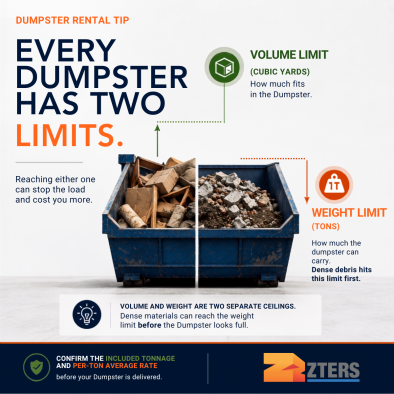
Because you hit the weight limit long before you fill the space. Volume and weight are two separate ceilings, and dense debris trips the weight one first. Same box, wildly different weight, depending on what goes in it.
Light, bulky debris fills the volume first. Cardboard, couches, deck lumber, and drywall offcuts pile up to the fill line while the weight stays low. Dense debris does the opposite. Concrete, dirt, and shingles hit the tonnage cap while the box still looks half empty. It is the difference between a box of pillows and the same box packed with bricks.
How many tons does each dumpster size hold?
Included tonnage rises with the box, but the exact allowance varies by hauler and local landfill rates. Treat the numbers below as industry ranges, not a promise. The figure to plan around is the one written on your quote.
| Dumpster size | Typical included tonnage | Common jobs |
|---|---|---|
| 10 yard | About 1 to 2 tons | Small tear-outs, concrete and dirt loads, single-room remodels |
| 20 yard | About 2 to 3 tons | Roofing, flooring, medium renovations |
| 30 yard | About 3 to 4 tons | New construction debris, large remodels, cleanouts |
| 40 yard | About 4 to 5 tons | Commercial builds, big demolition, high-volume light debris |
These allowances are not standardized across the industry, so a 30 yard box from one provider may include more or less weight than the next. Always confirm the included tonnage and the per-ton overage rate before the box is dropped. See the roll-off dumpster rental page for sizes, and our guide to what can and can’t go in a roll-off dumpster for the materials that drive weight.
How are per-ton overage charges calculated?
If your debris weighs more than the included tonnage, you pay a per-ton overage on the excess weight only. The rate is set by your hauler and the local landfill, and it commonly runs in the tens of dollars per additional ton, though it swings with region and disposal costs.
Here is the math with generic numbers. Say your 30 yard box includes 3 tons and the overage rate is $75 per ton. Your load weighs 5 tons. You are 2 tons over, so the overage is 2 times $75, or about $150 on top of the base rental. Your actual allowance and rate are on your quote, so use those, not these placeholders.
How is my dumpster weight actually measured?
Your loaded box is weighed at a certified landfill or transfer-station scale. The scale records the full gross weight, then subtracts the empty tare weight of the truck and container. The difference is your debris weight, and that is the only number that counts against your allowance.
The empty dumpster’s own weight does not count against you. The scale ticket is the objective record behind any overage, and on a legitimate account you can ask to see it. If you run multiple sites, keeping those tickets is worth the effort. They are your paper trail when an invoice looks off.
Which materials are deceptively heavy?
A handful of common materials fill your weight allowance fast, often while the box still looks half empty. Know these before you load, because they are the usual reason an overage fee appears.
- Concrete, brick, and asphalt. Roughly a ton or two per cubic yard. A single cubic yard of solid concrete weighs about as much as a compact car.
- Dirt, soil, and sand. Dense and deceptively heavy, and heavier still after rain.
- Roofing shingles. A full tear-off stacks up in weight quickly, especially with multiple layers.
- Tile and stone. Same heavy inert category as concrete, easy to underestimate.
- Wet or rain-soaked debris. Drywall, carpet, and mulch soak up water and gain real weight sitting in an open box.
A full large box of clean concrete would exceed the truck’s legal weight on its own, so heavy inert material usually belongs in a dedicated heavy-debris container with its own weight cap, not mixed into a general-debris load. Ask before you put concrete or dirt in a standard box. Federal highway weight rules for hauling vehicles are set by the Federal Highway Administration, and disposal rules vary by state and landfill, so confirm the current limits for your own site. See the FHWA commercial vehicle size and weight overview for the road side of it.
How do you estimate a load’s weight before you rent?
A rough formula gets you close. Estimate the debris weight, then match it against the included tonnage before you pick a box.
- Estimate the volume. Figure out how many cubic yards of material you expect. For roofing, count it in squares, where one square equals 100 square feet of tear-off.
- Multiply by weight per cubic yard. Use a rough per-material weight, then run cubic yards times pounds per cubic yard divided by 2,000 to get tons.
- Compare to the allowance. Line your estimated tons up against the included tonnage on the quote. If you are close to the cap, size up or split the load.
- Round up and ask. When in doubt, round up and call your provider. Sizing it right the first time is cheaper than an overage or a second haul.
How do you avoid dumpster overage fees?
You avoid overage fees by planning for weight up front, not by hoping the load comes in light. A few habits handle most of it.
- Size for weight, not just space. Match the box to both the volume and the tonnage the debris will actually carry.
- Separate heavy inert material. Put concrete, dirt, and brick in a dedicated heavy-debris container instead of the general load.
- Estimate first. Run the formula above before you rent, so the tonnage cap is a known number, not a surprise.
- Do not overfill the box. Loads above the fill line cannot be legally hauled and get bumped back to you, delaying the swap.
- Keep debris dry. Cover the box where you can, because wet material adds weight you pay for.
- Ask the two numbers up front. Get the included tonnage and the per-ton overage rate in writing before the drop.
Managing several sites at once makes this harder, not easier, because every crew loads a little differently. Pairing your dumpsters with your temporary fencing, portable toilets, and storage containers under one plan keeps the sizing consistent and the invoices readable across every location.
What should you look for in a dumpster provider?
Look for a provider who states the tonnage limits and overage rate plainly and stands behind them. Clear tonnage, a clear overage rate, and a scale ticket you can actually see are the marks of an account that will not surprise you.
- Tonnage in writing. The included weight and per-ton overage appear on the quote, not buried in fine print.
- Scale tickets on request. They can produce the certified weigh ticket behind any overage charge.
- Heavy-debris options. They offer dedicated concrete and dirt containers instead of quietly letting you overload a standard box.
- One point of contact across sites. If you run more than one jobsite, one account manager beats a different vendor and a different rate at every location.
How ZTERS coordinates dumpster service across your sites
ZTERS coordinates your dumpster service so dumpster weight limits and overage fees are the same story on every jobsite. Rather than sending our own trucks, we tap a vetted network of vendor partners and stay accountable for the whole account, which means one contact who knows your tonnage, your overage rate, and your schedule across all of it.
That is one plan and one invoice for dumpsters, and for the rest of your temporary site services, from portable offices and trailers to junk removal, nationwide across all 50 states. When a job runs heavy on concrete or dirt, we line up the right heavy-debris container instead of letting a standard box go over. You get consistent sizing, fewer surprise fees, and a single number to call when something needs to change. Site Services Simplified. One partner. One contact. One invoice.
Ready to size it right the first time? Get a dumpster rental quote and we will confirm the included tonnage and overage rate before anything hits your site.
Frequently asked questions
How many tons can a 20 yard dumpster hold?
Industry norms are roughly 2 to 3 tons included, but it varies by hauler and landfill. Check your quote for the exact allowance before you load.
What is a dumpster overage fee?
It is a per-ton charge for weight beyond your included tonnage, billed after the loaded box is weighed at a certified scale. You pay only on the excess weight.
Why can’t I fill the dumpster all the way up?
Weight, not just space, is capped. Dense debris hits the tonnage limit and the truck’s legal road limit before the box looks full, so a box that appears half empty can still be over weight.
Do I need a special dumpster for concrete or dirt?
Usually yes. Heavy inert material belongs in a dedicated heavy-debris container with its own weight cap. Ask before mixing it into a general-debris load, and we will set you up with the right box.