

Dumpsters & Permitting
Do You Need a Dumpster Permit? Who Pulls It and What It Costs
The rules change at every city line, and in several major markets you are not the one allowed to apply. What contractors need to know before the container is scheduled.
The container is booked. The crew is ready. Then the city tells you the dumpster permit should have been pulled two weeks ago, and that you were never the one allowed to pull it. The delivery slides. So does the schedule behind it.
What catches contractors out is almost never the application itself. It is that in several major markets the permit legally cannot be held by you or by the property owner. Here is how dumpster permits work, who is allowed to hold one, and what it takes to keep a container legal across more than one jurisdiction.
The short version
A dumpster permit is a city authorization to occupy the public right of way with a container, meaning the street, a parking lane, an alley, a sidewalk, or the curb strip. On private property you control, you usually do not need one. Every rule beyond that is local: who may apply, how long the permit runs, how the container has to be marked, and what it costs. In some cities the permit is yours to pull, in others only your service provider can pull it, so confirm that before the container is scheduled rather than after.
Jump to your city
Do you need a dumpster permit?
It depends on where the container will sit. Private property you control usually needs no permit. Public right of way almost always does.
On private property you control
Usually no permit. A driveway, a private lot, or an owner’s yard is normally fine, as long as the container does not block a fire lane or a required access route. The constraints here are practical rather than legal: ground bearing, overhead clearance, and a straight shot for the truck. Our guide on where to place a construction dumpster covers the siting decision in detail.
In the public right of way
Almost always yes. That covers the street, a parking lane, an alley, a sidewalk, and the strip of grass between sidewalk and curb. Cities treat this as temporarily occupying public space, which is why the permit is often called a street occupancy, street use, or public way permit rather than a dumpster permit. Search the city site for the phrase it uses locally. And if the container blocks a sidewalk, a crosswalk, or an accessible route, expect to need a pedestrian protection plan on top of the permit, which is a separate review with its own lead time.
What about HOA and private community rules?
They run alongside the city permit, not instead of it. An association can set its own limits on placement, duration, screening, and hours, and enforce them whether or not you hold a valid city permit. Get its written sign off at the same time you file with the city.
Who is legally allowed to pull a roll off dumpster permit?
That depends on the city, and it is the part most guides skip. In some markets the permit is yours to pull. In others it belongs to the company that supplies the container, or to whichever of you holds a local registration.
New York City
The Department of Transportation requires a container permit for a container placed on a city street or sidewalk, and it states plainly that permits must be obtained by a carting company or a general contractor, not by the property or business owner. For a Construction Debris Container permit, the applicant has to be a carting company registered with DOT or a registered general contractor, the permit has to be posted at the worksite, and the permit term runs from 30 up to 90 days. The shorter Commercial Refuse Container permit is a different animal: it covers one container for a much shorter stretch, so read which permit you are actually applying for before you plan around the dates. Current terms and applicant rules are on the NYC DOT container permits page.
Chicago
Under Municipal Code 10-28-799, the permit holder is the “provider,” defined as the person who leases or otherwise provides the dumpster for temporary use at the requested location. Not the contractor. Not the owner. The provider also has to carry commercial general liability insurance of at least $1,000,000 naming the City as an additional insured, and post an irrevocable standby letter of credit of at least $5,000 with the City as beneficiary. A service provider that does not already hold those instruments cannot legally place a container on a Chicago street for you.
Philadelphia
Philadelphia splits the question in two, and there is no single dumpster permit. The container needs an annual construction dumpster license from Licenses and Inspections, held by the company that owns or leases out the box and carrying an RFID medallion that stays on the container. The curb space needs a separate right of way permit from the Streets Department, billed by the week, and that applicant has to hold a Philadelphia contractor license or commercial activity license.
So the supplier licenses the container and you permit the street, and a gap on either side stops the job. Expect an insurance certificate naming the City as an additional insured, reflective warning devices on the container, and temporary no parking signs posted a day or two ahead. Confirm current fees with both departments, because they publish separately.
Minneapolis
Both parties need standing here. You must be a licensed contractor to apply for a street use permit, and the container itself has to come from a City-licensed solid waste hauler, wrecking contractor, or storage container company. A licensed contractor with an unlicensed supplier is still stuck, and so is a licensed supplier working for an unlicensed contractor.
Madison, Wisconsin
Contractors, property owners, and neighborhood associations can all apply for a street occupancy permit, so the applicant question is less restrictive. The gate here is insurance: a certificate has to be on file with City Risk Management before the permit issues, which means the filing is the long-lead item, not the form.
The pattern matters more than any one city. Five markets, five different answers to the same question. Assuming wrong costs you days, and in a permit-strict city it can cost you the delivery window entirely.
What do cities require beyond the application?
A permit number is rarely the end of it. Most cities attach marking, lighting, setback, and covering conditions to the permit, and those conditions are what inspectors actually check. Chicago’s ordinance shows how specific this gets.
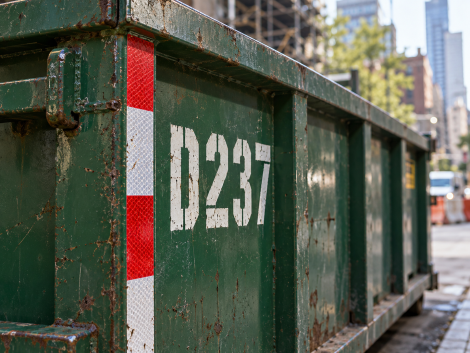
- Identification on the container. The provider’s name, phone number, and a unique ID must appear on both long sides, in lettering at least 3 inches high and legible from 30 feet.
- Retro-reflective sheeting. High-intensity sheeting on all four corners, at least 3 feet long and 2 inches wide along each side of the corner.
- Setbacks from infrastructure. No placement within 20 feet of a fire hydrant, within 40 feet of a bus stop, or within 10 feet of a crosswalk, an intersection, or an accessible parking space.
Minneapolis adds its own set. The container has to sit within 12 inches of the curb, in front of or beside the permitted address, and at least 30 feet from the corner on a corner lot. It has to be covered outside working hours. And the permit is not valid during street cleaning or a snow emergency, which can mean pulling the container until the street is plowed curb to curb.
Conditions are also where the money is. Chicago fines unpermitted placement at $250 to $1,500 per offense, $500 to $3,000 in the Central Business District, with every day counting separately, and repeat citations at one site can trigger a 10 day stop work order. That is the kind of penalty that outruns the cost of the permit many times over.
How do you get a dumpster permit?
Work backward from the delivery date, and settle the applicant question first. The sequence below holds in most cities even though the forms and the department names change.
- Confirm the container’s exact footprint. Street, driveway, alley, or curb strip, and whether any part of it crosses the property line. This answer alone decides whether you need a permit.
- Find the right permit name. Check the city’s transportation or public works site for street occupancy, street use, or public way occupancy. “Dumpster permit” is often not the official term.
- Settle who applies. Ask the city whether the contractor, the owner, or the service provider holds the permit, and whether a local license is a prerequisite.
- Get the insurance in order. Pull the certificate, add the city as an additional insured if required, and file it with the right office. A letter of credit or bond is rarely same day, so start it early.
- File with lead time. A week ahead is a reasonable floor, and permit-strict cities take longer. Treat it as a long-lead item, not a day-of task.
- Brief the crew on the conditions. Marking, covering, setbacks, and the posted permit. Conditions get cited far more often than applications get denied.
- Diary the expiry. Put the end date in the schedule and the amendment deadline a week before it, so an extension is paperwork instead of a fine.
Match the permit to the container size you ordered
Size can change the permit, the fee, and sometimes the eligible location. Chicago, for example, prices its dumpster permits in two classes split at 30 cubic yards, so a 40 yard box and a 20 yard box are not the same application. Fix the size before you file, because upsizing mid-job means amending the permit.
Line the permit up with delivery day
The permit start date should sit on or before the delivery date, never after it. A driver who arrives to an unpermitted street placement has two options, and both cost you: leave with the container, or set it down and expose the account to a citation from day one. Confirm the permit is in hand before you release the delivery.
What does a dumpster permit cost, and how long does it last?
Fees are set locally and vary widely, and most permits are time-boxed somewhere between 30 and 90 days. Treat any single figure as an example of the range rather than a number you can budget nationally. The table below shows how far apart five cities can be on the same four questions.
| City | Who applies | Permit term | Condition to watch |
|---|---|---|---|
| New York City | Carting company registered with DOT, or a registered general contractor. Not the owner. | 30 to 90 days for a construction debris container | Permit posted at the worksite |
| Chicago | The provider that leases or supplies the container | Priced for 1 to 3 days or by the month, amendment required to extend | $1,000,000 insurance naming the City, plus a $5,000 letter of credit |
| Philadelphia | Two instruments: the supplier licenses the container, a city-licensed contractor permits the street | Container license annual, street permit billed by the week | RFID medallion on the container, City named as additional insured |
| Minneapolis | A licensed contractor, with a City-licensed supplier providing the container | 30, 60, or 90 days | Covered outside working hours, void in a snow emergency |
| Madison, WI | Contractor, property owner, or neighborhood association | Up to 90 days | Insurance certificate on file with City Risk Management |
On the fees themselves, Madison charges a flat $50 per 30 days or portion of 30 days. Chicago tiers its fee by container class with a short-stay rate and a monthly rate, plus an application fee that rises on arterial streets and in the Central Business District. Budget for more than the fee either way: insurance filings, a letter of credit where one is required, reflective marking, and the labor to apply and amend all sit on top of the number on the fee schedule. Running past the end date is not a grey area, so diary the expiry and start any amendment while the permit is still valid.
Authority note: permit fees, terms, and applicant rules are set by each municipality and change without much notice. Every figure above comes from the city’s own published material, but confirm the current rule and fee schedule with the city that governs your jobsite before you file or budget. Where a container sits in or beside a travel lane, your traffic control also has to meet the work zone standards in the FHWA Manual on Uniform Traffic Control Devices, Part 6, as adopted by your state.
Can you avoid needing a permit?
Sometimes, and it is worth checking before you file. Two routes come up most often on real jobs.
- Move the container onto private property. Giving up two parking spaces on the owner’s lot, or steel plating a driveway to protect it, is often cheaper and faster than a street occupancy permit with an insurance filing attached. Walk the site before assuming the street is the only option.
- Use scheduled junk removal instead of a standing container. On a tight downtown site, or for a short punch list phase, a crew that arrives, loads, and leaves the same day avoids occupying the right of way at all. It does not suit high-volume demo, but it fits finish work well.
One caution. A permanent container at an occupied building needs no right of way permit, but local zoning, screening, and enclosure rules may still apply. If the project ends with the building in service, settle the ongoing waste service and its enclosure requirements before the temporary container leaves.
How do you run dumpster permits across multiple jobsites?
Assume one permit per container, per address, per city. There is no national dumpster permit, and no city will accept another city’s.
For a contractor running several sites, that means a different applicant rule, term length, fee, and set of placement conditions in every jurisdiction, each with its own expiry date. The failure mode is almost never a rejected application. It is a permit that quietly expires on site four while everyone is focused on site one. Two habits keep it manageable.
- Keep one register. Every active container with its city, permit number, issue date, expiry, and the name of whoever holds it. One sheet, not one per project manager, and schedule the amendment or the pickup backward from the expiry rather than forward from delivery day.
- Standardize on providers already registered in your markets. In a city like Chicago, Philadelphia, or New York, an unregistered service provider means there is no legal way to pull the permit at all, no matter how good the price was.

How ZTERS coordinates dumpster permits across your sites
ZTERS places containers through a vetted network of service providers in all 50 states, so the registration question is usually settled before it becomes your problem. Rather than sending our own trucks, we match each jobsite to a provider that can legally operate in that jurisdiction, which is the exact step that stalls contractors in permit-strict cities.
Across a dozen sites in a dozen jurisdictions, that means one point of contact instead of a dozen vendor relationships, one plan that lines deliveries up with the phases of each build, and one invoice at the end of the month. Tell us the jobsite address when you request service and we will flag the permit requirement before delivery rather than after.
Site Services Simplified. One partner. One contact. One invoice.
Frequently asked questions
Do I need a dumpster permit for a container in my own driveway?
Usually no. Permits are tied to occupying the public right of way, so a container sitting entirely on private property you control normally does not need one. A homeowners association may still have its own placement rules, and the container must not block a fire lane or required access route.
Who applies for a dumpster permit, the contractor or the rental company?
It depends on the city, and this is the most common point of confusion. New York City requires a DOT-registered carting company or a registered general contractor, and states the property owner cannot apply. Chicago puts the permit on the provider that supplies the container. Philadelphia splits it between a container license held by the supplier and a street permit held by a city-licensed contractor. Confirm the rule locally before assuming the permit is yours to pull.
How much does a dumpster permit cost?
Fees are set by each municipality and vary widely, so there is no national figure. Madison charges a flat $50 per 30 days. Chicago tiers its fee by container class and adds an application fee that rises downtown. Check the city’s current fee schedule, and budget for insurance filings and any required letter of credit on top of it.
How long is a dumpster permit valid?
Commonly 30 to 90 days, though short-stay and weekly permits exist in some cities. Minneapolis issues 30, 60, and 90 day street use permits, Madison caps street occupancy at 90 days, and Philadelphia bills its street permit by the week. Extending usually requires a formal amendment filed before the permit lapses, not after.
What happens if you place a dumpster without a permit?
Fines, removal, and sometimes a stop work order. In Chicago, placing a dumpster without a permit carries $250 to $1,500 per offense and $500 to $3,000 in the Central Business District, each day counts separately, and citations on three or more separate days within three months at the same site can trigger a 10 day stop work order. Philadelphia can seize an unlicensed container from the right of way. Check the local penalty before you take the risk.
How far in advance should you apply for a dumpster permit?
At least a week, and earlier in permit-strict cities. Where insurance filings, a license check, or a letter of credit are required, the paperwork behind the application takes longer than the application itself. Treat the permit as a long-lead item alongside your other project permits, not a day-of task.
Ready to line up dumpsters for your sites without chasing permits city by city? Get a free quote from ZTERS or call (888) 251-2660.