

Site Services Management
Site Services Broker vs. Direct Vendor
Two ways to buy restrooms, dumpsters, and fencing for your jobsites. One point of contact, or a dozen. Here is how the two models actually compare.
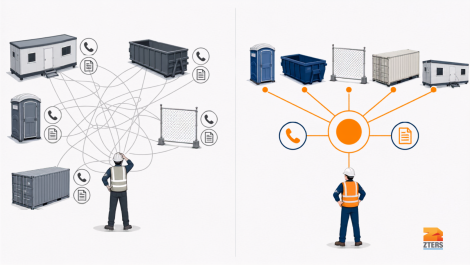
You need a restroom, a dumpster, and a run of fence on a jobsite. So you call three companies. Now multiply that by four active sites. That is a dozen phone numbers, a dozen contracts, a dozen invoices, and a dozen people to chase when a delivery misses its window. The work is not hard. The coordination is.
That is the choice behind site services broker vs direct vendor. You can source each service straight from the company that owns the equipment, or you can run everything through one partner who arranges it all for you. Here is what each model does, where each one wins, and how to tell which fits the way you actually work.
tl;dr
The short version: A direct vendor owns the trucks and equipment and sells you one service in the area it covers. A site services broker does not own equipment. It arranges and manages many services through a vetted network of vendors, and gives you one point of contact, one plan, and one invoice across every site. Direct is often simplest for a single service on a single site. A broker earns its keep once you are running multiple services, multiple sites, or multiple regions and the coordination becomes the real job.
What is a direct vendor?
A direct vendor is the company that owns the equipment and delivers the service itself. When you rent a roll-off from a local hauler or book restrooms from a regional porta-potty company, you are buying direct. You deal with the people who own the trucks, set the routes, and control the schedule.
Direct vendors are usually specialists in one service and one footprint. That has real strengths and real limits, depending on how many services and sites you run.
- One relationship, one service. You get direct pricing and direct control over the one thing they provide, whether that is roll-off dumpsters, portable restrooms, or temporary fencing.
- Local knowledge. A good regional vendor knows the routes, the landfills, and the permit quirks in its own service area.
- Coverage stops at their border. A vendor only serves where its trucks run. Cross a state line or open a site in a new market and you are back to square one, finding and vetting a new company.
- You are the coordinator. Every service you add means another contract, another contact, and another invoice that you manage and reconcile.
What is a site services broker?
A site services broker arranges and manages your temporary site services through a network of vendor partners, without owning the equipment itself. Instead of you calling five companies, the broker sources the right vendor for each service and each location, then stays accountable for the whole account. You get one point of contact instead of a stack of them.
The key thing to understand: a broker is not a middleman that just passes your call along. It vets the vendors, negotiates the service, coordinates deliveries and swaps against your schedule, and rolls everything into one plan and one invoice. The trucks belong to the vendor partners. The account belongs to you and the broker.
- One contact for everything. Restrooms, dumpsters, fencing, storage containers, portable offices, jobsite security, and junk removal run through the same person.
- One plan across sites. Deliveries, swaps, and pickups are sequenced against your build phases, not booked one call at a time.
- One invoice. Every service and every site consolidates into a single bill, which cuts the reconciliation work for your back office.
- Coverage that follows you. A broker with a nationwide vendor network can stand up services in a new market without you sourcing and vetting local companies yourself.
Site services broker vs direct vendor: what is the real difference?
The real difference is who does the coordinating. With a direct vendor, you own the coordination: you find each company, manage each contract, and chase each delivery. With a broker, that coordination shifts to your partner, and you manage one relationship instead of many. The equipment is often the same. The overhead is not.
| Factor | Direct vendor | Site services broker |
|---|---|---|
| Owns the equipment | Yes | No, arranges through vetted vendor partners |
| Services covered | Usually one | Many, under one account |
| Points of contact | One per vendor | One, total |
| Invoices | One per vendor, per site | One consolidated invoice |
| Geographic reach | Its own service area | Nationwide vendor network |
| Who coordinates | You | The broker |
| Best fit | Single service, single site | Multiple services, sites, or regions |
Neither model is automatically cheaper. A broker can often hold competitive rates through vendor relationships and volume, but any savings depend on your number of sites and the mix of services you run. The clearer win from a broker is time: fewer calls, fewer contracts, and fewer invoices to reconcile.
When does a direct vendor make sense?
A direct vendor makes sense when the job is simple and local. One service, one site, one market you already know. If you need a single dumpster for a single teardown in a town where you have a hauler you trust, there is little for a broker to coordinate.
- Single service. You need one thing, not a mix of restrooms, fencing, and storage together.
- Single site in one market. Everything sits inside one vendor’s service area, so coverage is not a problem.
- An existing relationship. You already have a vendor who shows up on time and knows your crew.
When is a site services broker the better choice?
A broker is the better choice the moment coordination becomes the hard part. If you run more than one service, more than one site, or work across regions, the direct model stacks up phone numbers and invoices fast, and every seam between vendors is a place for a delay to hide. For a closer look at that tipping point, see our guide on when to partner with a site services provider.
- Multiple sites at once. Running several active jobsites means the same sourcing and chasing work repeated over and over, per site.
- A mix of services. When restrooms, dumpsters, fencing, and storage all land on the same site, one plan beats four separate schedules.
- Work in new or multiple markets. Expanding into an unfamiliar region means a broker’s vendor network saves you from vetting local companies cold.
- A back office drowning in invoices. If reconciling dozens of bills is eating admin hours, one consolidated invoice pays back fast.
What should you look for in a site services broker?
Look for a broker that stays accountable for the whole account, not one that just hands off your order. The value is in coordination and follow-through, so judge a broker on how it manages the work after the booking, not just on the quote.
- A vetted vendor network. Ask how they select and hold vendors accountable, so a weak local partner does not become your problem.
- True single point of contact. Confirm you get one person or team for every service and site, not a different rep per line item.
- Consolidated billing. One invoice across services and sites is the whole point. Make sure it is real, not marketing.
- Nationwide reach. If you expand, the broker should already cover the markets you are heading into.
- Accountability when something slips. Ask who you call when a delivery misses its window, and what they do about it.
Whichever model you choose, confirm any service meets the rules for your site. For construction restroom counts, the standard is OSHA 1926.51. Check the current requirement at the source, OSHA 1926.51, and see our plain-language breakdown in the OSHA rules for construction portable toilets guide. Regulations change, so verify the current rule for your own site.
How ZTERS coordinates site services as your broker
ZTERS works as a broker, not an equipment owner. We arrange and manage your temporary site services through a vetted network of vendor partners, and we stay accountable for the whole account. You bring the jobsites. We line up the restrooms, dumpsters, fencing, storage, offices, security, and junk removal, and we sequence it all against your schedule.
That means one point of contact, one plan, and one invoice, nationwide across all 50 states. When a site opens in a new market, you do not start over. When a delivery needs to move, you make one call. The vendors run the trucks. We run the account.
Site Services Simplified. One partner. One contact. One invoice.
Frequently asked questions
Is a site services broker more expensive than a direct vendor?
Not necessarily. A broker can hold competitive rates through vendor relationships and volume, but any savings depend on your number of sites and the mix of services. The consistent gain is time saved on coordination, sourcing, and invoice reconciliation.
Does a broker own the trucks and equipment?
No. A broker like ZTERS does not own equipment. It arranges service through a vetted network of vendor partners and stays accountable for the account, giving you one contact, one plan, and one invoice.
When should I use a direct vendor instead?
Use a direct vendor for a single service on a single site in a market you already know, especially if you have a reliable local company. The broker model earns its keep once you are juggling multiple services, sites, or regions.
Can a broker handle jobsites in different states?
Yes. A broker with a nationwide vendor network can stand up services across all 50 states, so you can open a site in a new market without sourcing and vetting local vendors yourself.