
Hurricane Preparedness
Construction Site Hurricane Preparedness: A Contractor’s Checklist
Secure, anchor, or pull every temporary unit before the storm, then recover fast. A field checklist for teams running more than one jobsite at once.
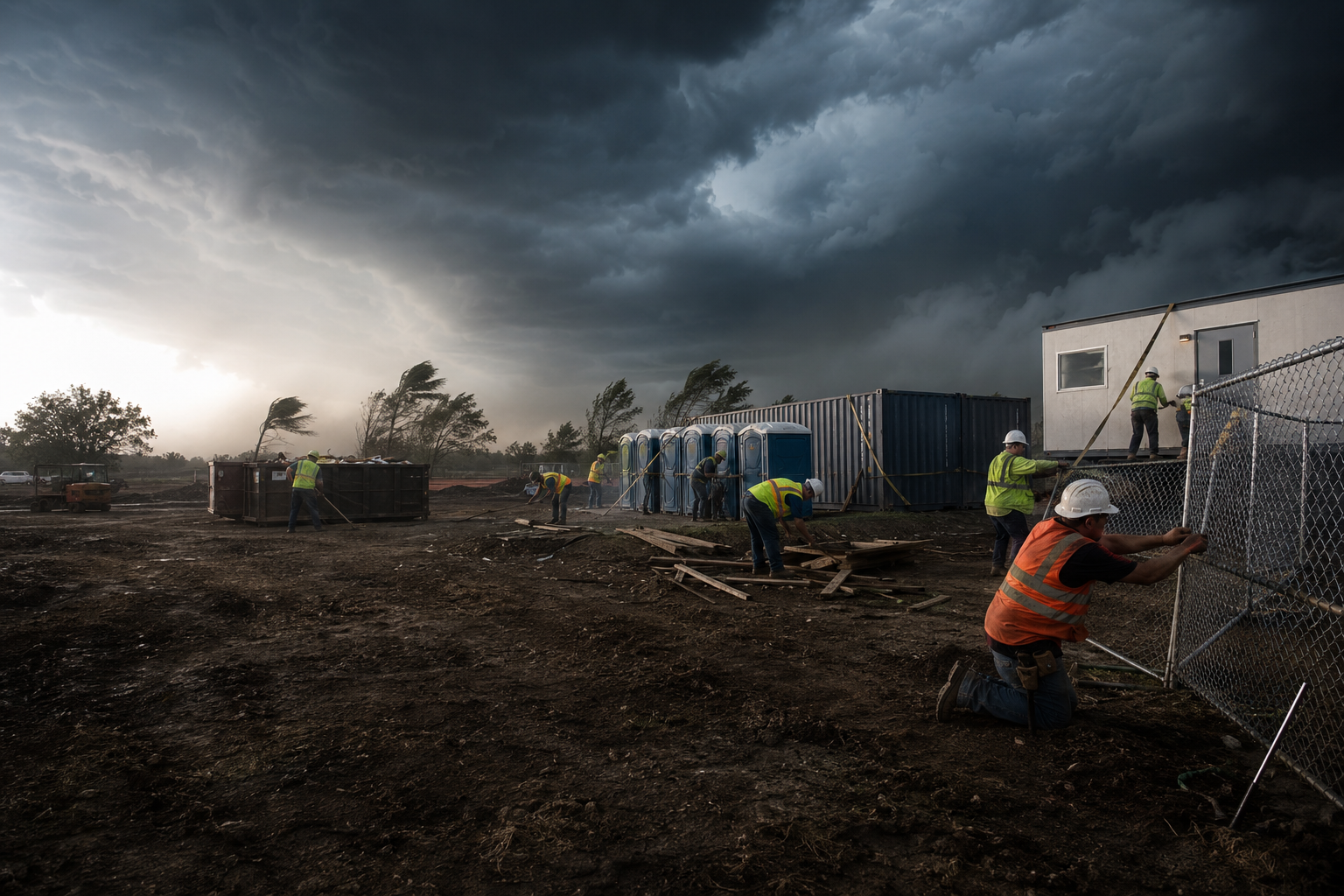
The cone shifts. You are 72 hours out, and you have six open jobsites scattered across the Gulf Coast. This is the moment construction site hurricane preparedness stops being a plan on paper. Each one has a fence line, two storage containers, a row of porta-potties, an office trailer, and a half-full roll-off. Suddenly you are making 30 phone calls to 30 vendors, trying to get every unit anchored or hauled before the wind picks up. Some answer. Some are already booked. The clock keeps running.
That scramble is what costs you. Lost days. Damaged equipment. Units that become projectiles and turn into a liability claim. Here is how to get ahead of it, and what solid construction site hurricane preparedness actually looks like when a storm is bearing down on more than one site at once.
The short version
Construction site hurricane preparedness means securing, anchoring, or removing every temporary unit and loose item on your jobsite before the storm, then having a fast plan for security and cleanup after. Start early, because vendor capacity disappears as the storm gets closer. Done right, you protect your crew, your equipment, and your schedule, and you avoid turning loose site gear into flying debris.
What is construction site hurricane preparedness?
Construction site hurricane preparedness is the plan and the physical work of getting a jobsite storm-ready before a hurricane or tropical storm makes landfall. It covers two phases: locking down the site before the wind arrives, and recovering safely once it passes.
On an active jobsite, that means dealing with everything that is not bolted to the ground. Temporary fencing, portable restrooms, storage containers, dumpsters, and office trailers all have to be anchored, emptied, weighted, or pulled off-site entirely. Loose materials, tools, and debris have to be cleared or contained. The goal is simple: nothing on your site should be able to move, tip, or fly when sustained winds hit.
Why do construction sites take so much hurricane damage?
Construction sites take heavy hurricane damage because they are full of loose, lightweight, and unfinished items that storms turn into hazards. A finished building is sealed and anchored. A jobsite is open, exposed, and stacked with movable gear.
A few things drive most of the damage:
- Wind turns site gear into projectiles. Empty porta-potties tip and tumble. Loose fence panels lift like sails. Stacked lumber, signage, and scrap scatter across the property and into the road.
- Standing water finds the low spots. Trenches, excavations, and graded pads collect water fast. Flooding undermines fresh work and floats anything that is not secured.
- Unanchored units move. Storage containers, trailers, and dumpsters that were set down without anchoring can slide or overturn in high wind and saturated ground.
- Theft spikes after the storm. Power is out, sites sit unattended, and copper, tools, and equipment disappear during the recovery window.
Hurricanes carry sustained winds of 74 miles per hour or higher, and the strongest can exceed 155 miles per hour. The National Hurricane Center rates them on the Saffir-Simpson scale from Category 1 to 5, and storms that reach Category 3 or higher are considered major hurricanes. Even a Category 1 storm is enough to scatter an unsecured site.
How do you prepare a construction site for a hurricane?
You prepare a construction site for a hurricane by working a checklist in order, starting as soon as a watch is issued for your area. A hurricane watch means conditions are possible within about 48 hours. A warning means they are expected within about 36 hours. Do not wait for the warning to start moving.
Here is a practical sequence for jobsite hurricane prep:
- Confirm the forecast and set your trigger points. Track the storm through the National Hurricane Center. Decide in advance what action happens at watch, at warning, and at evacuation order, so nobody is improvising at hour 60.
- Activate your emergency action plan. Make sure every crew member knows the evacuation route, the shelter location, and who to call. Review your plan against OSHA’s hurricane preparedness guidance and your local requirements.
- Stop work and secure the structure. Brace or cover unfinished framing, board up openings, and tie down anything attached to the building that could tear loose.
- Clear and contain loose materials. Remove scrap, signage, and small tools. Anything light enough to fly should be inside a container or off-site. Schedule a junk removal or final dumpster pickup before haulers stop running.
- Anchor, empty, or remove site service units. This is the big one for multi-site teams. Empty and secure the portable restrooms, anchor or pull the storage containers and office trailers, and take down or reinforce the temporary fencing. See the table below for what to do with each.
- Protect documents and electronics. Move plans, permits, and equipment out of trailers that could flood. Back up anything digital off-site.
- Set up post-storm security. Plan for the period when the site is dark and unattended. Confirm your jobsite security coverage before you leave.
- Document the site. Photograph everything before the storm. You will need it for insurance and for proving the condition you left it in.
Which site service units need to be secured, anchored, or removed?
Every temporary unit on your site needs a plan, and that plan is rarely “leave it as is.” Empty units are the most dangerous because they are light enough to move. Use the table below as a starting point, and confirm anchoring specs with each provider, since the right action depends on the unit, the ground, and the expected wind.
| Unit | Risk if left untreated | Recommended action before the storm |
|---|---|---|
| Portable restrooms | Tip and tumble; empty units fly easily | Service, then strap and stake down, lay flat in a sheltered spot, or remove |
| Temporary fencing | Panels act like sails and lift away | Remove panels, or reinforce with extra bracing and weighted bases |
| Storage containers (20, 40 foot) | Slide or shift on saturated ground | Anchor per spec, lock, and relocate off any low or flood-prone ground |
| Office trailers | Overturn in high wind; flood and contents loss | Anchor and tie down, clear out documents and electronics, or relocate |
| Roll-off dumpsters (10, 20, 30, 40 yard) | Lightweight debris becomes airborne | Empty or pull before haulers stop running; never leave loose debris exposed |
| Loose materials and junk | Scatter across the site and into roads | Containerize or clear with a final junk removal run |
Authority note: Anchoring and tie-down requirements vary by unit, manufacturer, and local code, and wind-load rules differ from one jurisdiction to the next. Confirm the current standards for your own site before the storm. OSHA’s hurricane preparedness page and FEMA’s Ready.gov hurricane resources are good starting points, and your local building authority is the final word.
What should you do after the storm passes?
After the storm, your first job is to confirm it is safe to return, then assess and document before anyone starts cleanup. Do not send crews back into a site with standing water, downed lines, or unstable structures until it has been cleared.
Work the recovery in order:
- Wait for the all-clear. Follow local authorities. Roads, power, and flood conditions decide when return is safe, not your schedule.
- Inspect before you enter. Check for structural damage, electrical hazards, gas leaks, and contaminated water before crews step on-site. OSHA’s response and recovery guidance covers the common hazards.
- Document the damage. Photograph everything for insurance, then compare against your pre-storm photos.
- Restore site services fast. Get restrooms, fencing, and security back in place so work can restart. Bring in dumpsters and junk removal to clear storm debris.
- Secure the site during recovery. Theft peaks in the days after a storm. Keep jobsite security active until the site is buttoned up and crews are back.
The faster you can re-establish services and clear debris, the faster the job restarts. That turnaround is where multi-site contractors win or lose weeks.
What should you look for in a site services partner before hurricane season?
Look for a partner who can move on every site at once, with one phone call, before the storm hits. Hurricane season is exactly when calling 30 individual vendors falls apart. The ones with capacity get booked first, and you are left exposed.
Evaluate partners on these factors:
- One point of contact. You should be able to trigger your whole storm plan through one person, not a different rep for every service and every market.
- Multi-site, nationwide reach. If your jobsites cross state lines, your partner should coordinate all of them under one account, in all 50 states.
- Full service range. Restrooms, dumpsters, fencing, containers, office trailers, security, and junk removal should all run through the same plan, so nothing falls through the cracks.
- A vetted vendor network. You want a partner who already knows which local providers can perform when a storm is inbound and capacity is tight.
- Fast recovery support. Storm prep is only half the job. The right partner gets your services and debris cleanup restored quickly so you can restart.
For restroom-heavy sites, it is also worth knowing the baseline rules before storm season. Our guide to OSHA portable toilet requirements for construction walks through the counts and standards you should already have in place.
How ZTERS coordinates hurricane preparedness across your sites
ZTERS coordinates construction site hurricane preparedness so you make one call instead of 30. When a storm is inbound, you tell your single point of contact what needs to happen, and ZTERS works the whole plan across every site.
Here is how the model works. ZTERS arranges and manages your temporary site services through a vetted network of vendor partners, and stays accountable for the entire account. So when you need restrooms serviced and secured, containers anchored, fencing pulled, dumpsters emptied, and security stood up before a hurricane, that all moves through one plan, one contact, and one invoice. Across all 50 states.
That matters most when the storm clears and the recovery race begins. ZTERS coordinates the cleanup the same way: junk removal, debris hauling, restored services, and security, all through the same account, so your sites get back to work faster.
Savings and turnaround depend on your number of sites and the mix of services, but the core advantage holds whether you run two jobsites or twenty: you are not chasing vendors during the worst week of the season. That is the idea behind Site Services Simplified. One partner. One contact. One invoice.
Frequently asked questions
When should you start preparing a construction site for a hurricane?
Start as soon as a hurricane watch is issued for your area, which is about 48 hours out. Vendor capacity disappears fast once a storm is named, so the teams that anchor and haul early are the ones that finish in time. Waiting for the warning, about 36 hours out, leaves too little room to work multiple sites.
What is the difference between a hurricane watch and a warning?
A hurricane watch means storm conditions are possible in your area within about 48 hours. A warning means they are expected within about 36 hours. Use the watch as your trigger to begin securing the site, not the warning.
Do you have to remove portable toilets before a hurricane?
Not always, but you do have to secure them, because an empty unit is light enough to tip and fly. Your options are to service it and then strap and stake it down, lay it flat in a sheltered spot, or pull it off-site entirely. The right call depends on the unit, the ground, and the expected wind, so confirm with your provider.
Does OSHA require a hurricane plan for construction sites?
OSHA requires employers to have an emergency action plan that covers evacuation and crew safety, and its hurricane preparedness guidance lays out what that should include for a jobsite. Specific anchoring and wind-load rules come from your local building code, so confirm the current standards for your own site.
How soon can crews return to a jobsite after a hurricane?
Only after local authorities give the all-clear and the site has been inspected for structural damage, downed lines, gas leaks, and contaminated water. Roads, power, and flood conditions decide when return is safe, not your schedule. Document the damage before anyone starts cleanup.