
Truck Driver Appreciation Week
Roll-Off Dumpster Delivery: What Happens Behind the Haul
You place one order. Behind it sits a dispatcher, a route, a scale ticket, and a driver with a 60 foot backing lane and a clock. Here is the whole chain, and how to keep it moving.
The box is full by Tuesday. You call for a swap. Wednesday comes and goes. The crew starts stacking debris on the slab because there is nowhere else to put it. By Thursday the pile is in the way of the framing crew, and you are losing hours to one thing: a roll-off dumpster delivery that did not happen.
Roll-off dumpster delivery looks like a single step: a truck brings a box. It is not. Between your call and that empty container sits a dispatcher, a routed truck, a legal weight limit, a certified scale, a landfill or transfer station, and a driver working against a federal clock. National Truck Driver Appreciation Week runs September 13 to 19, 2026, so this is a good week to walk the whole chain. Understanding it is also the fastest way to stop losing days to missed swaps.
The short version
Roll-off dumpster delivery is the full cycle that moves a container from a hauler’s yard to your jobsite and back out again: order, dispatch, route, drop, fill, haul, weigh, tip, and return. A driver runs the physical half of it inside a licensed truck, a legal weight limit, and federal hours-of-service rules. When you know what each stage needs, you can clear the two things that stall most swaps, which are site access and load weight, and your boxes turn on schedule.
What happens after you order a roll-off dumpster delivery?
Your order becomes a routed stop on a driver’s day, not a standalone trip. Dispatch assigns the container to a truck that is already running a loop of drops, swaps, and returns, then sequences your site into that loop based on distance, box availability, and how much weight the truck can legally carry on the way back.
Here is the sequence, start to finish.
- The order lands with dispatch. Size, debris type, delivery window, and site address go into the routing system. Debris type matters here, because a concrete load and a framing load are routed to different facilities.
- Dispatch builds the route. Your stop is grouped with nearby drops and pickups. This is why “first thing in the morning” is rarely a promise a hauler can make: you may be stop six.
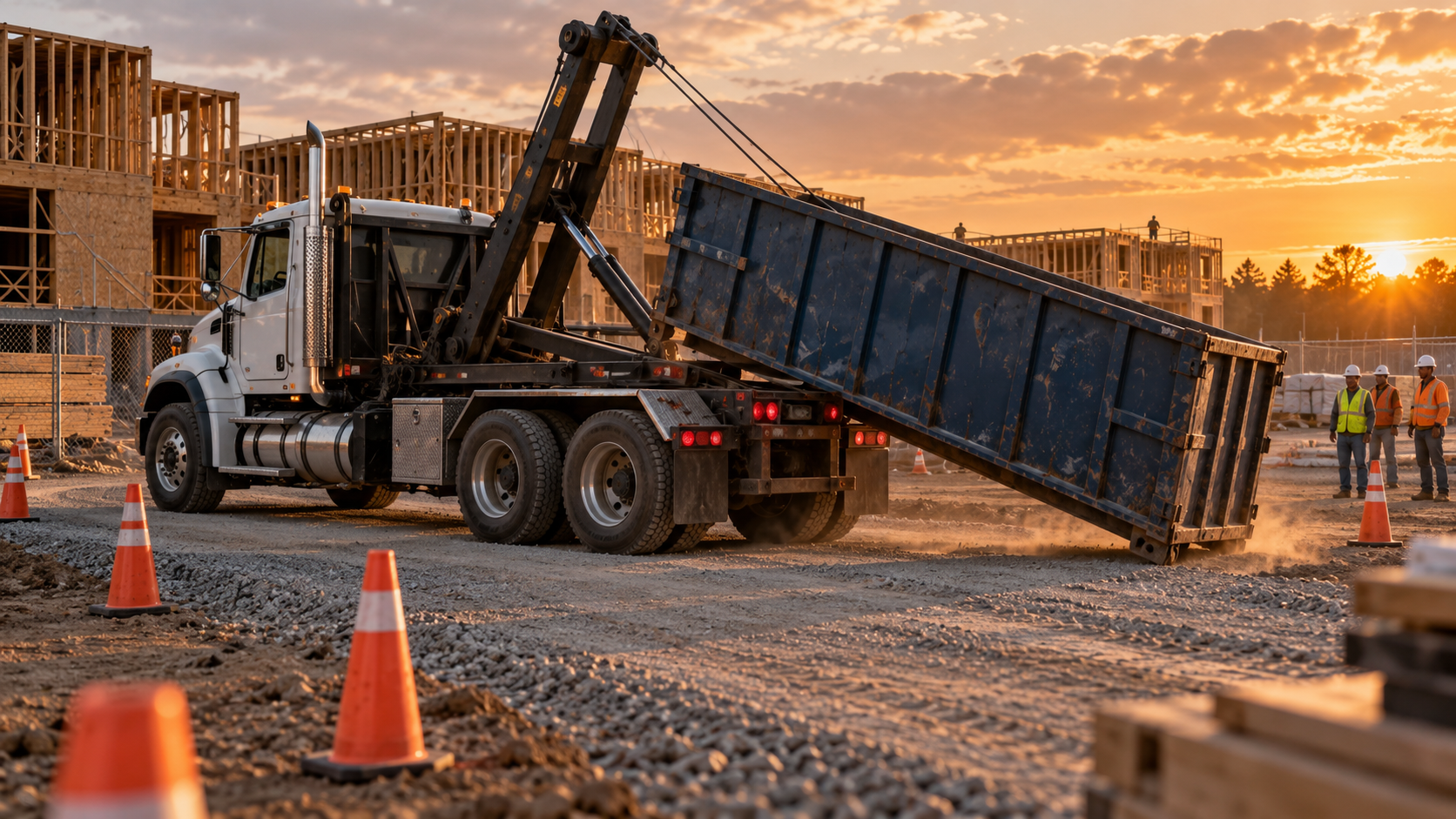
- The driver pulls the box and runs the lane. A roll-off truck is a hoist on a chassis. The driver needs a straight, clear, reasonably level lane to back in and winch the container off the rails.
- Your crew fills it. Level load, doors closed, nothing above the rim. Anything over the rail is a load the driver legally cannot tarp and move.
- The driver hauls it out. Same lane, same clearance, plus enough room for a loaded truck that is now several tons heavier and much slower to maneuver.
- The load is weighed at a certified scale. The scale ticket is where your tonnage is recorded, and it is the document behind any overage line on your invoice.
- The material is tipped and sorted. At a transfer station or C&D facility, recoverable material like clean concrete, metal, and wood is pulled out. The EPA tracks construction and demolition debris in the hundreds of millions of tons a year, and much of that C&D material is recoverable rather than landfilled.
- The empty box comes back. On a swap, steps three through eight repeat as one round trip, which is why a swap is a scheduling event and not a phone call.
Does the size of the box change the route?
It changes availability more than distance. Haulers carry a limited number of each size in each yard, so a 30 yard box on a busy demo week can be the constraint that pushes your drop to the next day. Ordering the right size the first time keeps you out of that queue, and it also keeps you from paying to move air.
Who is behind the dumpster on your jobsite?
A licensed commercial driver, a dispatcher, and a scale house, at minimum. The driver is the one who has to make your site work in real time, and they are doing it inside rules most jobsites never think about.
- A CDL holder, not a delivery driver. Roll-off trucks are commercial motor vehicles. The person dropping your box holds a commercial license and carries the liability for how that load leaves your site.
- A driver on a federal clock. Property-carrying drivers are capped at 11 driving hours after 10 consecutive hours off duty, inside a 14 hour on-duty window, under FMCSA hours-of-service regulations. Thirty minutes lost waiting at a blocked gate is thirty minutes that comes off someone else’s stop.
- A dispatcher balancing a shrinking bench. The American Trucking Associations has flagged a persistent driver shortage driven by retirements outpacing new entrants, which is part of why tight same-day windows are harder to hold than they were a decade ago.
- A scale house that sets your invoice. Your tonnage is not estimated by eye. It is recorded on a certified scale, and that ticket is the record you can ask for.
- A facility with its own acceptance rules. Landfills and transfer stations publish their own banned-item lists, and a driver who takes a non-compliant load is the one turned away at the gate.
The American Trucking Associations runs National Truck Driver Appreciation Week from September 13 to 19, 2026, honoring the roughly 3.6 million professional drivers moving freight in the United States. A meaningful share of them are the reason your site is not buried in its own debris.
Why do dumpster swaps get delayed?
Most delayed swaps are not dispatch failures. They are dry runs: the truck arrived, the driver could not take the load, and the stop was rescheduled. A dry run usually costs you a trip charge and a day.
The box is overloaded or over the rail
A driver cannot legally haul a load stacked above the container rail, because it cannot be tarped and it can shed debris on the road. Weight is the other ceiling. Dense material like concrete, dirt, and tear-off shingles hits the legal axle limit long before the box looks full, and an overweight box gets left behind.
The wrong material went in the box
One paint bucket, one propane tank, or one set of tires can get a whole load rejected at the gate. The driver then has to bring it back, and you pay for the round trip plus the sort. Post the banned list where the crew loads, not in the trailer.
The truck cannot reach the box
This is the most common one and the most preventable. A pickup parked at the head of the lane, a material delivery staged across the approach, a locked gate with a code nobody left, soft ground after two days of rain, or a low utility line over the drop point. Any one of them ends the stop.
Nobody called until the box was already full
Routes are usually built a day ahead. Calling at 4 p.m. for a next-morning swap puts you at the back of a route that is already sequenced. Call at 75 percent full, not at 100 percent, and you get placed instead of squeezed in.
How much room does a roll-off truck need?
Plan on roughly 60 feet of straight approach, about 10 to 12 feet of width, and about 25 feet of overhead clearance for the hoist to raise. Those figures are typical, not universal, and they change with truck configuration and box size. The table below is a planning starting point.
| Box size | Typical footprint | Approach lane to plan for | Common jobsite use |
|---|---|---|---|
| 10 yard | About 12 ft long, 8 ft wide, 3.5 ft tall | About 55 to 60 ft straight, 25 ft overhead | Concrete, dirt, and other heavy inert debris |
| 20 yard | About 22 ft long, 8 ft wide, 4.5 ft tall | About 60 ft straight, 25 ft overhead | Roofing tear-offs and mid-size renovation |
| 30 yard | About 22 ft long, 8 ft wide, 6 ft tall | About 60 ft straight, 25 ft overhead | New construction framing and general C&D |
| 40 yard | About 22 ft long, 8 ft wide, 8 ft tall | About 60 ft or more straight, 25 ft overhead | High-volume, low-density debris and large demo |
Authority note: dimensions and clearances vary by hauler, truck, and local ordinance, and street placement often requires a right-of-way permit from your municipality. Confirm the exact clearance and permit requirements for your box and your jurisdiction before the truck rolls. Weight limits are separate from volume and are governed by federal and state axle rules, so also confirm the included tonnage in your contract.
How do you make your jobsite easy to service?
Treat the drop point as a permanent site feature, the same way you treat the gate or the laydown yard. Sites that do this get their swaps on time, and the ones that do not spend the whole job rescheduling.
- Pick the drop point before mobilization. Mark it on the site logistics plan with the approach lane drawn in, not just an X where the box goes. Check for overhead lines and low branches while you are standing there.
- Cone or barricade the lane. An unmarked approach becomes a parking spot by week two. A few cones and a “keep clear” sign cost less than one dry run.
- Put boards or plates under the box on soft ground. Plywood or steel plate keeps the container from sinking and keeps the truck from rutting the lane it has to use again next week.
- Give the hauler a real site contact and gate access. A name, a cell number that gets answered, and the gate code. Not the main office line.
- Call the swap at 75 percent full. Build it into the superintendent’s daily walk. This one habit removes most emergency swap calls.
- Separate heavy inert debris. Keep concrete, brick, and dirt in their own box. It protects your tonnage on the mixed load and it keeps both boxes legal to haul.
- Load level and close the doors. Nothing above the rail, doors latched before the truck arrives. The driver should not be reshuffling your load.
Does any of this change what you pay?
Yes, mostly through the fees you avoid. Dry run charges, trip charges, overage tonnage, and contamination sorting are all line items that come from something that happened on your side of the fence. A clear lane and a level load are the cheapest cost controls on the job. Worth reading your agreement closely too, since dumpster rental contracts spell out which of these apply.
How ZTERS coordinates roll-off dumpster delivery
ZTERS runs the coordination layer between your sites and the trucks. Rather than sending our own trucks, we tap a vetted network of vendor partners and stay accountable for the whole account, so when a swap slips you have one number to call instead of a hauler in each market.
For a contractor running six jobs across three states, that means one plan covering sizes, swap cadence, and debris separation across every site, one point of contact who already knows your access constraints, and one invoice instead of a stack of them. We service all 50 states, and the same account can carry your portable restrooms, temporary fencing, storage containers, and junk removal alongside the dumpsters.
The drivers still do the hard part. Our job is to make sure the route, the box, and the site line up so they can. Site Services Simplified. One partner. One contact. One invoice.
Frequently asked questions
How long does roll-off dumpster delivery take?
Most haulers deliver within one business day of the order, and many can do same-day if you order early and the size is in the yard. Your stop is placed on a route with other drops and pickups, so a specific hour is usually a window rather than a guarantee.
Does someone need to be on site for the delivery?
Not usually, as long as the drop point is marked, the lane is clear, and the driver can get through the gate. Give the hauler a site contact who answers a cell phone in case the truck arrives to a blocked approach.
What is a dry run fee?
A dry run fee is what you are charged when the truck arrives and cannot complete the job, usually because the lane was blocked, the gate was locked, the box was overfilled, or the load was not legal to haul. The driver still made the trip, so the stop is billed and rescheduled.
How full can you fill a roll-off dumpster?
Level with the top rail, and no higher. Debris above the rail cannot be tarped, so the driver cannot legally move it. You also have a separate weight ceiling, and dense material often hits that limit before the box is visually full.
When is National Truck Driver Appreciation Week 2026?
September 13 to 19, 2026. The American Trucking Associations organizes it each year during the second full week of September to recognize the professional drivers who move freight, including the roll-off, restroom service, and container drivers who keep jobsites running.
What is a good way to thank a driver during Truck Driver Appreciation Week?
Clear the lane, load level, and have the gate open. Drivers consistently say the best thing a site can do is let them get in and out without waiting. Coffee and a thank you go a long way too, but the clear approach is the one that saves their day.
Ready to line up roll-off dumpster delivery for your sites? Get a free quote from ZTERS or call (888) 251-2660.