
Portable Offices
Mobile Office Trailer Rental Cost: A Contractor’s Guide
What a jobsite office really costs, by size. Monthly rates, delivery and setup fees, permits, and the rent versus buy math.
Mobile office trailer rental cost is almost never the number you got over the phone. You budget the monthly rate. The first invoice lands well above it. Delivery. Blocking and leveling. Skirting. Steps. A permit nobody pulled. A removal fee at the end nobody priced. None of it is hidden, exactly. It just was not in the rate you were quoted.
On a short rental, the monthly rate is the small part of the bill. Here is what a jobsite office actually costs by size, what moves the price, when renting beats buying, and how to get a quote you can hold a vendor to.
tl;dr
Mobile office trailer rental cost generally runs about $150 to $400 a month for a small 8 by 20 single-wide and roughly $700 to $1,800 a month for a large double-wide, based on 2026 national figures published by third-party cost guides. Delivery and setup commonly add about $1,000 to $5,000, removal is billed separately at the end, and a temporary structure permit often runs a few hundred dollars more. Your real number depends on size, rental term, season, distance from the vendor’s yard, and how much prep the ground needs before the unit lands.
What is a mobile office trailer?
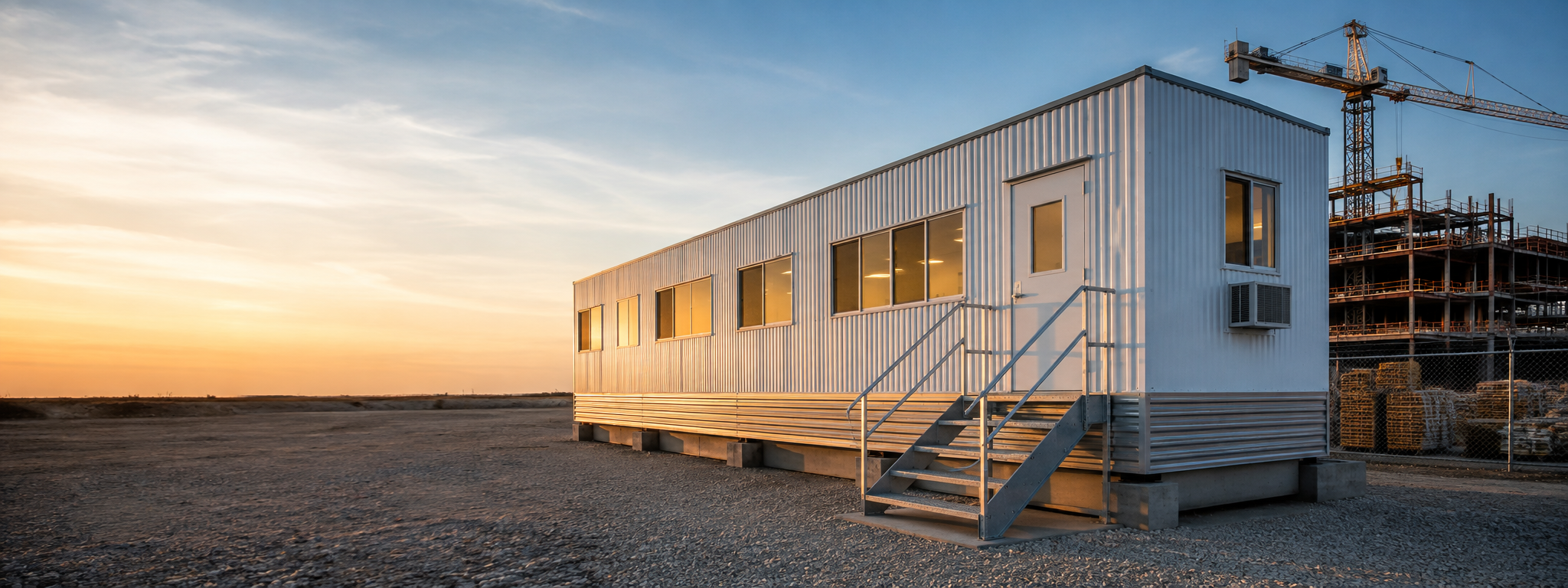
A mobile office trailer is a towable office unit delivered, leveled, and anchored on your site so your team has a real workspace next to the work. Superintendents run the day out of it. Plans, submittals, safety documents, toolbox talks, and inspector meetings all land in the same room instead of the cab of a truck.
Contractors usually price two products against each other. A mobile office trailer, also called a construction trailer or jobsite office, sits on blocks a few steps off the ground. Single-wide units run from small 8 by 20 boxes up to 12 by 60 layouts, and double-wides join two sections into a much larger floor plan with private offices, conference rooms, and sometimes restrooms. A converted container office is a storage container modified for office use, installed at ground level, with fewer interior options but simpler placement. Sizes, layouts, and add-ons vary by market.
How much does a mobile office trailer rental cost per month?
Most jobsite office trailers rent for roughly $150 to $1,800 a month, with small single-wides at the low end and large double-wides at the top. The table below shows the ranges third-party cost guides published for 2026. These are base monthly rates only. Delivery, setup, and removal are quoted separately.
| Unit | Approximate size | Typical monthly range | Best fit |
|---|---|---|---|
| 8 x 20 single-wide | 160 sq ft | $150 to $400 | 1 to 3 people, tight sites, short jobs |
| 10 x 40 or 12 x 40 single-wide | 400 to 480 sq ft | $250 to $700 | Small team, desks plus a meeting corner |
| 12 x 60 single-wide | 720 sq ft | $450 to $900 | Superintendent and PM team, private office, plan table |
| 24 x 60 and larger double-wide | 1,440 sq ft and up | $700 to $1,800 | Large teams, conference room, multiple private offices |
| 20 ft container office | 160 sq ft | $250 to $500 | Ground-level access, small crews, short durations |
| 40 ft container office | 320 sq ft | $400 to $850 | Office space plus secure storage in one footprint |
Treat these as national averages, not quotes. Published ranges from cost guides such as Metal Buildings and CostOwl disagree with each other by several hundred dollars on the same unit, which tells you something useful: office trailer rental prices are a local market question, not a national one. Demand on the coasts tends to run hotter than in the South and Midwest, and the closest yard carrying the floor plan you want usually sets your price.
What does delivery and setup cost for an office trailer?
Delivery and setup commonly run about $1,000 to $5,000, and you pay a version of it twice, once to bring the unit in and again to take it out. Transport is usually billed by the mile, so distance from the vendor’s yard matters as much as the unit itself. On a 3 month rental these one-time charges can cost more than the rent.
- Transport in and out. Hauling is priced on mileage, and the return trip at the end of the term is a separate line that is easy to forget when you are comparing monthly rates.
- Blocking, leveling, and anchoring. The crew sets the unit on blocks, levels it, and ties it down. High-wind and flood-prone areas often require engineered anchoring, which costs more.
- Steps, ramps, and landings. Some vendors include steps, others quote them per door. An ADA compliant ramp costs more than steps and needs considerably more room, so flag it early.
- Skirting. Metal skirting to close off the space under a trailer is usually a separate line and scales with the size of the unit.
- Site prep and lifting equipment. Ground that is not level, soft, or hard to reach adds cost. Ground-level container offices sometimes need a forklift or crane on delivery day.
- Utility hookups. Electrical is the big one, plus water and sewer if the unit has a restroom. No power at the pad yet means a generator or a temporary drop.
- Permits. Temporary structure permits commonly run in the low hundreds, and some vendors add a fee to handle the paperwork for you.
- Furniture and add-ons. Desks, chairs, plan tables, and file cabinets are typically a monthly package. HVAC upgrades, extra electrical, security bars, and network equipment price separately.
- Damage waiver and insurance. Most vendors either sell a monthly damage waiver or require you to name the unit on your policy. Check which before the invoice tells you.
This pattern is not unique to offices. The same surprise line items run through every site service, which is why we broke down the most common dumpster rental hidden fees the same way.
What determines your mobile office trailer rental cost?
Size and rental term move the price more than anything else, followed by how far the unit has to travel and what shape your ground is in. These are the factors a vendor is actually pricing when they build your quote.
- Square footage and floor plan. An open 8 by 20 is the cheapest unit in most fleets. Every private office, conference room, and interior wall you add moves you up a tier.
- Rental term. Month-to-month carries the highest rate because the vendor is pricing the risk of an idle unit. Committing to 6 or 12 months usually brings the monthly number down.
- Season and local demand. Peak construction months tighten supply and can push rates up, while the slow winter stretch is easier to negotiate in. Booking in the off season can hold a better rate for the whole term.
- Distance from the yard. Transport is billed on mileage, so a site 20 miles from a vendor’s lot and a site 200 miles out are not the same job even with the same trailer.
- Region. The same construction office trailer prices differently in a dense coastal metro than in a rural market with one yard and three units.
- Site conditions. Level, compacted, accessible ground is cheap to set on. Slopes, mud, tight turns, and overhead lines all add labor and equipment.
- Restroom in the unit. A trailer with a restroom needs water and waste service and costs more than a dry unit. Many teams skip it and cover the crew with portable restrooms instead, which is usually the cheaper path.
- Volume across sites. One trailer is a transaction. Six trailers across four states is a program, and it prices differently.
Is it cheaper to rent or buy a mobile office trailer?
Renting is usually cheaper under about 2 years, and buying starts to win somewhere past the 24 to 36 month mark. Published guides put a new jobsite trailer in the range of roughly $16,000 to $30,000, with larger modular office buildings higher, and used units in decent shape well below that. Divide the purchase price by the monthly rental rate and you have a rough break-even in months.
| Consideration | Renting | Buying |
|---|---|---|
| Upfront cost | First month plus delivery and setup | Full purchase price plus transport |
| Best duration | Under roughly 24 months | Roughly 3 years or more |
| Maintenance and repairs | Usually the vendor’s problem | Yours, including HVAC and roof |
| Moving between jobsites | Vendor handles transport and setup | You arrange and pay each move |
| Storage between projects | Not your issue, unit goes back | You need a yard and it sits idle |
| Flexibility | Swap sizes as the team changes | Locked into one floor plan |
| Balance sheet | Operating expense on the job | Capital purchase with resale value |
The break-even math also misses something contractors feel every year. An owned trailer has to be hauled between jobs, stored when no project needs it, repaired when the HVAC quits, and replaced when it ages out. If your projects are 9 to 18 months and spread across markets, renting per site usually beats owning one unit you keep dragging across the state.
Should you rent an office trailer or a container office?
Rent a container office when you need ground-level access, a small footprint, or office and secure storage in one place. Rent a mobile office trailer when you need more room, a real floor plan, or space for a team that will grow.
| Factor | Mobile office trailer | Container office |
|---|---|---|
| Access | Raised on blocks, needs steps or a ramp | Ground level, walk straight in |
| Sizes | Wide range, up to large double-wides | Usually based on 20 ft or 40 ft containers |
| Interior options | Private offices, conference rooms, restrooms on larger units | More limited, simple layouts |
| Setup | Blocking, leveling, anchoring, skirting | Simpler placement, may need lifting equipment |
| Moving it on site | Harder once set | Easier to relocate as the site changes |
| Security | Standard doors and windows, bars optional | Steel shell, strong for storing gear |
| Best for | Longer projects, larger teams, client-facing use | Short jobs, small crews, office plus storage |
Either one is a target after hours. A jobsite office holds laptops, plans, and sometimes tools, so plan the perimeter around it with temporary fencing and, on sites that warrant it, jobsite intrusion detection rather than hoping a padlock holds.
Do you need a permit for a mobile office trailer?
Usually yes. Most jurisdictions treat a jobsite office as a temporary structure that requires a permit, and many want a site plan showing where the unit sits in relation to property lines, exits, and other structures. Build the approval time into your mobilization schedule, not into delivery week.
The International Building Code addresses this in Section 3103, Temporary Structures, which generally treats temporary as a period of less than 180 days and limits permits accordingly, with extensions available at the building official’s discretion. Adoption and local amendments vary widely from one city or county to the next, so confirm the current requirements with the authority having jurisdiction over your site before you schedule delivery.
Accessibility is the requirement contractors miss most often. The ADA does not carve out an exception for temporary buildings, so an office used by staff or open to clients and the public can require an accessible route, which in practice means a compliant ramp instead of steps. Ramp slope, landings, and door clearances are set out in the 2010 ADA Standards for Accessible Design, with additional technical guidance from the U.S. Access Board. A ramp also takes far more room than a set of steps, which is a site layout problem as much as a cost one.
Adding an office does not change your sanitation obligations for the crew either. Restroom counts on construction sites are set under OSHA 1926.51 and any stricter state or local rules. Our guide to OSHA rules for construction portable toilets walks through the counts, and if you are pricing that side too, we broke down what it costs to rent a porta potty the same way.
How long does it take to get an office trailer delivered?
Plan on roughly 1 to 2 weeks in most markets, faster if a stock unit is sitting in a nearby yard and slower for large or custom floor plans. Industry guides report common lead times around 7 to 10 days, with some suppliers delivering in a few business days and custom configurations stretching to several weeks in peak season.
Minimum rental terms vary just as much. Some vendors run month to month with 30 days notice, others hold a 3 month minimum. That difference matters most on short jobs, because a 6 week project on a 3 month minimum means you pay for 3 months. Ask about the minimum term and the early termination terms in the same conversation as the rate, and remember the permit clock runs alongside the lead time.
How do you get an accurate portable office quote?
Give the vendor enough detail that they cannot re-price you later. Five minutes of prep is what separates a quote you can budget against from a number that changes after delivery.
- Count the people and the uses. How many desks, whether you need a private office for confidential conversations, whether inspectors or clients will meet in there, and whether you need a plan table.
- Pin the dates. Give a delivery window and an expected end date. A term the vendor can plan around usually prices better than an open-ended rental.
- Describe the pad honestly. Where the unit will sit, how level it is, the surface, and how a truck gets to it. Underselling access problems only moves the cost to delivery day.
- Confirm utilities. Say whether power is on site, what amperage is available, and whether you need a generator. Do the same for water and waste if the unit has a restroom.
- Settle the access question. Steps or an ADA ramp, and who pulls the temporary structure permit. Both change the price and the schedule.
- Ask for the all-in number. Request delivery, setup, steps, skirting, anchoring, damage waiver, and removal as separate written lines, not a single monthly figure.
- Price the rest of the site at the same time. Offices rarely land alone. Quote temporary fencing, dumpsters, restrooms, and storage together so the schedule and the billing line up.
If you are still building out the rest of the mobilization, our construction site services coordination checklist walks through what to line up and when, and the wider guide to coordinating construction site services covers how the pieces sequence across phases.
What should you look for in a portable office provider?
Look for transparent pricing, coverage where you actually build, and one person who owns the account when something goes wrong. Rate alone is a bad way to choose, because the cheapest monthly number often carries the least predictable fees.
- Itemized quotes. Every charge on paper before delivery, including the removal fee you will not see until the job ends.
- Coverage in your markets. If you run sites in several states, a provider who can only serve two of them puts you back to sourcing local vendors job by job.
- Realistic lead times. Floor plans with private offices and restrooms go first in peak season. Ask what is actually available in your market, not what is in the catalog.
- Service after delivery. HVAC fails, locks stick, steps shift. Ask who you call and how fast they respond.
- Flexibility when the schedule slips. Projects extend and end early. Find out what changing the term costs before you need to change it.
- One account, not seven. A provider who can cover the office, fencing, restrooms, dumpsters, and storage keeps your admin time down and your billing in one place.
If you are weighing how to source this across several jobs, our breakdown of the site services broker vs direct vendor models covers the tradeoffs.
How ZTERS coordinates mobile office trailer rentals
ZTERS coordinates your portable office rentals so you deal with one partner instead of chasing a different trailer vendor in every market. Rather than running our own trucks, we work through a vetted network of vendor partners and stay accountable for the whole account. You tell us the team size, the site conditions, and the schedule, and we line up the right unit, coordinate delivery, leveling, setup, and utility hookups, and pull it off site when the job wraps.
That means one point of contact, one plan, and one invoice, nationwide across all 50 states. Extend a rental, swap to a bigger floor plan when the team grows, or open a site in a market you have never worked in, and you make one call instead of starting a vendor search. The vendors run the equipment. We run the account. And when the same site needs fencing, restrooms, dumpsters, or storage, it runs through the same plan.
Site Services Simplified. One partner. One contact. One invoice.
Frequently asked questions
How much does it cost to rent a mobile office trailer per month?
Roughly $150 to $1,800 a month based on 2026 national figures from third-party cost guides. A small 8 by 20 unit sits near the bottom of that range, a 12 by 60 single-wide falls in the middle at about $450 to $900, and a large double-wide reaches the top. Delivery, setup, and removal are billed separately, so price each site to get a real number.
How much does delivery and setup cost for an office trailer?
Commonly about $1,000 to $5,000, and you pay a version of it twice because removal at the end is a separate charge. The fee covers transport, blocking, leveling, and anchoring, and transport is usually billed by the mile. Distance from the vendor’s yard and the condition of your ground are the two things that move it most.
Is it cheaper to rent or buy a mobile office trailer?
Renting is normally cheaper for anything under about 2 years. Published guides put the break-even somewhere around 24 to 36 months, with new jobsite trailers running roughly $16,000 to $30,000 to buy and used units well below that. Divide the purchase price by the monthly rate for a quick break-even, then factor in what you will spend hauling, storing, and repairing a unit you own.
Do you need a permit for a mobile office trailer on a jobsite?
Usually yes. Most jurisdictions treat a jobsite office as a temporary structure requiring a permit, and many ask for a site plan showing the unit’s placement relative to property lines and exits. The International Building Code treats temporary as less than 180 days in Section 3103, but local adoption and amendments vary, so confirm the current requirements with the authority having jurisdiction over your site.
Does a mobile office trailer have to be ADA compliant?
Often, yes. The ADA does not exempt temporary buildings, so an office used by staff or open to clients and the public can require an accessible route, which usually means a ramp rather than steps. Ramp slope, landings, and door clearances come from the 2010 ADA Standards for Accessible Design. Because a compliant ramp needs much more space than steps, decide this before you fix the trailer’s location on the site plan.
How long does it take to get an office trailer delivered?
Usually 1 to 2 weeks. Industry guides report common lead times around 7 to 10 days, and a stock unit in a nearby yard can move in a few business days. Large or custom floor plans, and anything ordered during peak construction season, can take several weeks. Add permit approval time on top, since that often runs longer than the delivery itself.
What is the minimum rental term for an office trailer?
It varies by vendor. Some run month to month with 30 days notice, while others hold a 3 month minimum. That gap matters on short jobs, because a 6 week project under a 3 month minimum means paying for 3 months. Ask about the minimum term and early termination terms in the same conversation as the monthly rate.
Is a container office cheaper than a mobile office trailer?
Often yes for small footprints, and the gap is usually bigger on setup than on rent. Container offices sit at ground level, so they skip steps, skirting, and blocking, which cuts the one-time charges. Once you need several hundred square feet, private offices, or a conference room, a mobile office trailer is normally the better value per square foot.
What size mobile office does a construction crew need?
Size it by how many people need desks and how the room will be used, not by crew headcount. An 8 by 20 covers 1 to 3 people. A 12 by 40 works for a small team with a meeting corner. A 12 by 60 suits a superintendent and PM team who need a private office and a plan table. Go double-wide when you need a conference room or multiple private offices.
Does a mobile office trailer come with furniture?
Not usually as standard. Desks, chairs, plan tables, and file cabinets are typically offered as a monthly furniture package, and availability varies by market. Confirm what comes with the unit itself, since HVAC, lighting, and electrical outlets are standard on most trailers while furnishings are not.
Does a longer rental term lower the monthly rate?
Usually. Month-to-month rentals carry the highest rate because the vendor is pricing the risk of the unit sitting idle. Committing to 6 or 12 months typically brings the monthly number down. Booking outside peak construction season can help too, since supply is looser and the rate you lock can carry through the term.
Does a mobile office trailer need power and water?
Power, almost always. Lighting, outlets, and HVAC need an electrical connection, so plan on a temporary drop or a generator if service is not at the pad yet. Water and sewer are only needed if the unit has a restroom, which is why many teams rent a dry trailer and cover the crew with portable restrooms instead.
Ready to price a portable office for your sites? Get a free quote from ZTERS or call (888) 251-2660.