
Waste Management
Temporary vs Permanent Waste Solutions for Job Sites
One is billed by the haul and follows the work. One is billed by the month and stays put. Here is how to tell which one your site needs, and when to switch.
Demo week is over. The 30 yard box that ran three swaps a week is now sitting half empty for ten days straight, and you are still paying for it. Two sites over, the building is occupied, the punch list is closed, and the property manager is still calling for roll-off swaps because nobody set up regular service. One site is overpaying. The other is running the wrong system entirely.
That is the choice behind temporary vs permanent waste solutions. Temporary service follows the work and gets billed by the haul. Permanent service stays in place and gets billed on a recurring schedule. Here is what each one is, what each one costs you, how they compare side by side, and how to know when your job site should move from one to the other.
Tl;dr
The short version: A temporary waste solution is short-term, project-based service, usually a roll-off dumpster, an on-call haul, or a junk removal pickup, priced per haul and sized to a phase of work. A permanent waste solution is ongoing service for a building or facility that is going to keep producing waste, usually a front-load container or a compactor on a set weekly pickup schedule, priced monthly. Job sites almost always start temporary because volume spikes, changes character, and then stops. The moment volume levels out and becomes predictable, permanent service is cheaper per ton. Getting the switch right at turnover is where most projects leave money on the table.
What are temporary vs permanent waste solutions?
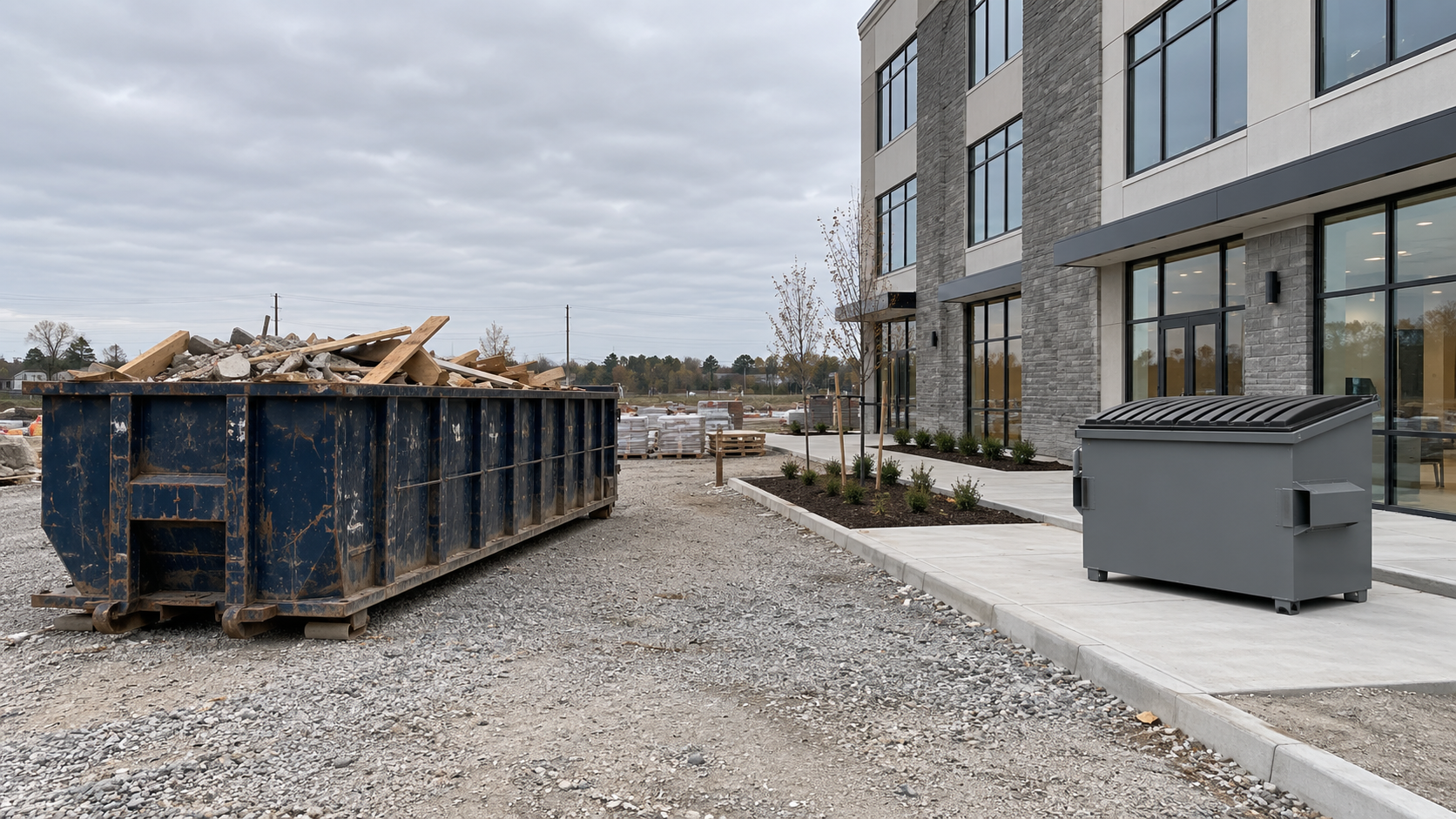
Temporary vs permanent waste solutions is the difference between service that ends when the project ends and service that runs as long as the building is in use. Temporary service is tied to a scope of work: you order it, you fill it, you get it hauled, and when the phase is done the container leaves. Permanent service is tied to an address: a container stays on site and a truck comes on a route schedule, week after week, whether the container is full or not.
The distinction matters because the two are priced on completely different logic. Temporary service charges you for movement. Permanent service charges you for presence. Run the wrong one and you either pay per haul for waste that shows up on a predictable schedule, or you pay a flat monthly rate for a site that is producing five times the volume the container can hold.
What counts as a temporary waste solution?
A temporary waste solution is any container or haul you order for a defined stretch of work and release when that work is finished. It is the default on active construction because volume is unpredictable, debris is heavy and bulky, and the container has to move as the work moves. It is also the bulk of what the industry throws away: the EPA puts construction and demolition debris at more than twice the tonnage of municipal solid waste, with demolition accounting for the large majority of it. Here is what falls in this category:
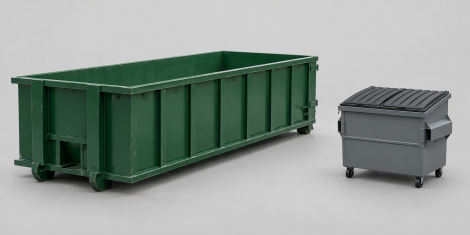
- Roll-off dumpsters. The workhorse of job site waste. Open-top boxes in 10, 20, 30, and 40 yard sizes, dropped by a hook truck and swapped when full. Priced per haul with a weight allowance built in.
- On-call swaps. No fixed schedule. You call when the box is full, which suits demo and framing where volume moves in bursts rather than on a rhythm.
- Junk removal hauls. A crew comes, loads, and takes it away. Useful for a one-time cleanout, a punch-list sweep, or debris in a spot no truck can reach with a container.
- Temporary compactors. On long, high-volume jobs, a compactor cuts the number of hauls dramatically. It costs more to place, so it pays off only when the volume is there and the project runs long enough.
- Separated debris containers. Dedicated boxes for concrete, clean wood, metal, or drywall when a project has diversion targets or when clean loads earn a lower disposal rate.
The same temporary logic applies to the rest of the site: portable toilets, temporary fencing, storage containers, and portable offices all come and go with the phases.
How do you size a roll-off for each phase?
Size to the phase, not to the project. Order too small and you pay for extra hauls. Order too big and you pay to move air. Demo and site work generally take a 30 or 40 yard box, structure and framing a 30 yard, finishes a 20 yard on a slower cycle, and punch list a 10 yard or a single haul. Adjust as the work changes instead of locking one size in for the whole schedule.
What can go in each type of container?
Roll-offs take most construction and demolition debris. Front-load bins do not. Either way, tires, batteries, paint, solvents, appliances with refrigerant, and anything classed as hazardous are out, and a contaminated load usually comes back as a surcharge rather than a phone call. Check the box on our dumpster rental page against your actual debris, and if you are trying to cut disposal cost across several sites, a waste audit is usually where the savings show up first.
What counts as a permanent waste solution?
A permanent waste solution is recurring service for a location that will keep producing waste indefinitely, set up on a contract with a fixed pickup schedule. This is what commercial waste services cover: the container stays, the truck comes on a route, and you are billed monthly rather than by the haul. What this looks like in practice:
- Front-load containers. The 2, 4, 6, and 8 yard bins behind almost every commercial building, emptied by a front-load truck on a set schedule, once a week up to daily.
- Carts. Wheeled 64 or 96 gallon containers for low-volume sites, small offices, or a trailer complex that does not generate enough to justify a bin.
- Permanent compactors. Stationary or self-contained units for facilities with steady high volume, such as manufacturing, distribution, and retail. High setup cost, low cost per ton once running.
- Recycling service. A separate stream for cardboard, single stream, or a baler. Often required by local ordinance or a corporate diversion target rather than chosen for cost.
- Scheduled service agreements. The contract behind all of it, which sets pickup frequency, term length, rate escalators, and what happens when your volume changes.
One thing to check before you shop this side around: many jurisdictions award exclusive collection rights for ongoing commercial service, so the hauler may already be decided for you. Los Angeles County’s commercial franchise system is a clear example, and notably it carves out temporary construction roll-offs, which stay open to any hauler. That split is why a site can be locked into one vendor for its permanent bin and still competitively bid its dumpsters.
How do temporary and permanent waste solutions compare?
Temporary service wins on flexibility and heavy debris. Permanent service wins on cost per ton once volume is steady. Everything else follows from those two facts. Here is the side-by-side.
| Factor | Temporary waste solution | Permanent waste solution |
|---|---|---|
| Typical equipment | Roll-off dumpster, 10 to 40 yard | Front-load bin, cart, or compactor |
| How you are billed | Per haul, plus weight overage | Monthly, based on size and frequency |
| Commitment | Days to months, no long contract | Contract term, often 12 to 36 months |
| Scheduling | On call, or scheduled swaps | Fixed route day, week after week |
| Best for | Demo, construction, renovation, cleanouts | Occupied buildings and running facilities |
| Handles heavy debris | Yes, concrete, roofing, framing lumber | No, front-load bins are not built for it |
| Volume it suits | Spiky and unpredictable | Steady and predictable |
| Placement | Moves as the work moves | Fixed pad or enclosure |
| Cost per ton | Higher | Lower once volume is steady |
The row that catches people out is heavy debris. A front-load bin is designed for bagged trash and cardboard, not for concrete, dirt, or shingles. Load a permanent bin with demo debris and you will get a refusal, an overweight charge, or both. That alone keeps most active job sites on roll-offs until the heavy work is done.
What does each model actually cost, once weight and overage are in?
Cost comparison is harder than it looks because the two are quoted in different units. A per-haul rate and a monthly rate are not comparable until you convert both to cost per ton for your actual volume. Watch the line items on either side: delivery, fuel, environmental fees, weight overage, and contamination charges all move the real number. For the temporary side, our breakdown of what it costs to rent a dumpster shows how those pieces stack up on a quote.
Which one does your job site need?
If the site has an end date, go temporary. If the site has an occupancy date, plan for permanent. Most projects need both, just not at the same time. Work through it in this order:
- Start with duration. Anything under a few months is temporary, full stop. Setting up a service contract for a 10 week renovation costs more in paperwork and early termination exposure than it saves.
- Then look at what the waste is. Concrete, dirt, roofing, and framing lumber need a roll-off, regardless of how long the job runs. Bagged trash, cardboard, and office waste can go in a front-load bin.
- Check whether the volume is predictable. Permanent service only saves money when you can size the container and frequency accurately. If your volume swings week to week, a fixed schedule either overflows or runs half empty.
- Map it to the phases. Demo and structure take the big roll-offs. Finishes take a smaller box on a slower cycle. Occupancy takes recurring service. Plan all three at the start so nothing gets ordered in a panic.
- Confirm placement and access. A roll-off needs about 60 feet of clearance and overhead room for the truck to lift. A permanent bin needs a pad or enclosure and a lane the front-load truck can reach on a route day.
- Check the local rules before you assume. Many cities run exclusive franchise agreements for ongoing commercial collection while leaving temporary construction roll-offs open to any hauler. That can decide the question for you.
When should you switch from temporary to permanent service?
Switch when the heavy debris stops and the volume becomes predictable, which on most projects is somewhere between the end of finishes and the certificate of occupancy. The tell is simple: when you are calling for a swap because the box has been sitting a while rather than because it is full, the temporary setup has outlived its purpose.
| Project phase | What the waste looks like | Right solution |
|---|---|---|
| Demo and site work | Heavy, dense, high volume in bursts | 30 or 40 yard roll-off, on-call swaps |
| Structure and framing | Bulky lumber, packaging, steady volume | 30 yard roll-off, scheduled swaps |
| MEP and finishes | Mixed, lighter, more packaging | 20 yard roll-off, slower cycle |
| Punch list and turnover | One-time sweeps and leftover material | 10 yard roll-off or a junk removal haul |
| Occupancy and operations | Bagged trash, cardboard, predictable | Front-load bin or compactor on contract |
Authority note: Construction and demolition debris is tracked and regulated differently from municipal solid waste, and many jurisdictions set diversion or recycling targets that apply to the temporary side of your plan. The EPA’s guidance on sustainable management of construction and demolition materials is a good starting point. State, county, and city rules vary widely, including franchise agreements that limit which hauler can service an occupied building, so confirm what applies to your own address before you sign anything.
Two practical notes on the handoff. First, do not let both run at once. Overlapping a roll-off and a new front-load contract for a month is one of the most common ways job sites quietly overpay. Second, get the commercial waste service ordered a few weeks before you need it. Route setup, container delivery, and enclosure access all take longer than a roll-off dumpster drop.
What about the punch-list haul in between?
Use a labor-based haul, not another container. At closeout the debris is scattered, awkward, and often inside a finished building, which is the one case where paying a crew to load beats dropping a box in a parking lot you have just restriped. Book it as a single pickup, keep it off the new front-load contract, and see our construction clean up guide for how the final sweep usually sequences.
What should you look for in a waste provider?
Look for a provider that can handle both sides of the switch without you re-sourcing halfway through the project. The equipment is the easy part. What costs you time is managing two vendors, two contracts, and two invoices across a handoff that happens on every job you run.
- Both temporary and permanent capability. One provider that covers roll-offs and recurring service means the transition at turnover is a schedule change, not a new procurement cycle.
- Transparent pricing on both models. Ask for per-haul rates with the weight allowance stated, and monthly rates with the escalator and term stated. Vague quotes get expensive later.
- Ability to scale mid-project. When demo runs long or the schedule compresses, you need a bigger box or a faster swap cycle this week, not next month.
- Contract terms you can live with. Check the term length, the auto-renewal clause, and the early termination fee. Permanent service contracts are where multi-site portfolios get locked in.
- Coverage across all your sites. If you run jobs in several markets, one provider that covers all of them beats managing a different local hauler per address.
- Documentation you can hand to an owner. Weight tickets, diversion reporting, and clean invoicing matter when a project has recycling targets or a client who audits.
Ask each candidate to quote both models on the same site, in writing, before you pick one. That is the fastest way to find out whether they actually run both sides or subcontract one of them without telling you.
How do you source this across a portfolio? Broker vs direct vendor
Direct vendors make sense when all your work sits in one market. Once you are running sites in several markets, no single hauler covers all of them, and you end up managing a different local contract, contact, and invoice per address. Coordinating that centrally is the whole argument for the broker model, and our guide to coordinating construction site services covers how the rest of the site fits the same pattern.
How ZTERS coordinates temporary and permanent waste solutions
ZTERS coordinates both the temporary and the permanent side of your waste plan so the handoff at turnover is one conversation instead of a new vendor search. Rather than sending our own trucks, we tap a vetted network of vendor partners and stay accountable for the whole account. You tell us the phases, the volume, and the occupancy date, and we line up the roll-off dumpsters for the build, then the commercial waste services for the finished building.
That means one point of contact, one plan, and one invoice, nationwide across all 50 states. Upsize a box for demo, slow the swap cycle for finishes, start front-load service the week the building opens, or open a site in a new market, and you make one call. The vendors run the trucks. We run the account. And when the same site needs portable toilets, temporary fencing, storage containers, jobsite security, or a junk removal sweep at closeout, it runs through the same plan.
Savings depend on your number of sites and the mix of services, but the pattern is consistent: fewer overlapping containers, fewer emergency hauls, and no month where you are paying for two systems at once.
Site Services Simplified. One partner. One contact. One invoice.
Frequently asked questions
What is the difference between temporary and permanent waste service?
Temporary service is project-based and priced per haul, usually a roll-off dumpster that arrives for a phase of work and leaves when it is done. Permanent service is ongoing and priced monthly, usually a front-load bin or compactor emptied on a fixed route schedule for as long as the building is in use. Temporary follows the work. Permanent stays with the address.
Is a roll-off dumpster temporary or permanent?
A roll-off dumpster is a temporary solution in almost every case. It is delivered by a hook truck, filled, hauled, and either swapped or removed, and it is billed per haul rather than monthly. Some facilities do keep a roll-off on a standing schedule for high-volume waste, but the standard permanent setup for an occupied building is a front-load container or a compactor.
Which is cheaper, a temporary dumpster or permanent waste service?
It depends on how steady your volume is. Permanent service is usually cheaper per ton once volume is predictable enough to size the container and the pickup frequency accurately. Temporary service is cheaper when volume is spiky or short-lived, because you only pay when the box actually gets hauled. The two are quoted in different units, so convert both to cost per ton for your real volume before comparing.
Can you put construction debris in a permanent front-load bin?
Usually no. Front-load bins are built for bagged trash and cardboard, not for concrete, dirt, roofing, or framing lumber. Heavy debris can damage the container, exceed the truck’s lift capacity, and trigger a refusal or an overweight charge. Keep construction and demolition debris in a roll-off, and check your provider’s prohibited-materials list before loading either type.
When should a job site switch from a roll-off to permanent service?
Switch once the heavy debris is done and the volume becomes predictable, which is typically between the end of finishes and occupancy. A good signal is when you are ordering swaps on a timer rather than because the box is full. Set the permanent service up a few weeks ahead, because route setup and container delivery take longer than a roll-off drop, and avoid running both at the same time.
Do you need a contract for a temporary dumpster?
Not usually. Temporary roll-off service is typically a rental agreement for a defined period with no long-term commitment, which is one of its main advantages on a project. Permanent service is different: it normally runs on a service contract with a term, an auto-renewal clause, and sometimes a rate escalator, so read those terms before you sign.
Can one provider handle both temporary and permanent waste across multiple sites?
Yes. A provider that coordinates both models lets you run roll-offs during construction and recurring service after occupancy without re-sourcing at the handoff, and it consolidates every site onto one point of contact and one invoice. That matters most for contractors and property managers running several addresses in different markets, where the alternative is a separate local hauler for each one.
What size dumpster does a construction site need?
It depends on the phase. Demo and site work usually call for a 30 or 40 yard roll-off, structure and framing tend to run a 30 yard, finishes work well with a 20 yard on a slower swap cycle, and punch-list cleanup often only needs a 10 yard or a single junk removal haul. Size to the phase rather than the whole project, and adjust as the volume changes.
Ready to line up waste service for your sites? Get a free quote from ZTERS or call (888) 251-2660.